I manage procurement for a mid-sized manufacturing plant. Last year, during our Q2 budget review, I sat staring at a variance report that didn't make sense. Component prices were slightly under budget, but our total spend was over by roughly $36,000. The gap came from things I hadn't tracked closely enough: expedited freight, rework labor, and three separate equipment swaps. That's when I stopped shopping on price alone.
If you're responsible for buying hydraulic filters, gear pumps, motors, or drives, this is going to sound familiar. Over the past six years of tracking every invoice in our cost system, I've learned that the problem isn't that industrial components are expensive. The problem is that we usually compare the wrong number.
The Surface Problem: Component Prices Seemed Fine
On paper, our price per unit was actually lower than the previous year. We'd switched a couple of line items to lower-cost suppliers and negotiated a small discount on others. The purchasing report looked good. So why was the total cost up?
The answer came from digging into failure records. A gear pump from a new source had a different shaft tolerance. An AC motor we bought for a conveyor upgrade didn't fit the mount (we didn't verify frame size). A brushless DC motor that was supposed to replace a servo in a tension control loop failed in the first week because no one checked the feedback requirement.
In other words, the components themselves were cheap. The misuse of them was expensive.
The Deep Cause: 'Same Specs' Doesn't Mean Same Result
I assumed 'same specifications' meant identical results across suppliers. Didn't verify. Turned out each had slightly different interpretations.
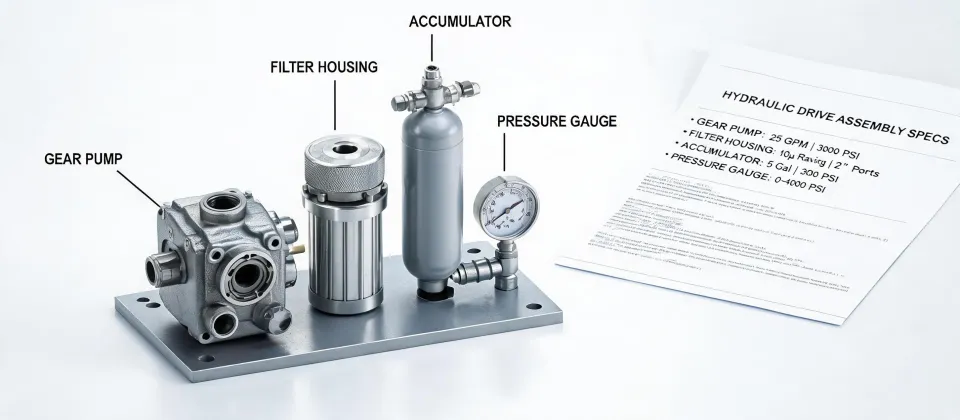
For example, we quoted a hydac gear pump from our preferred distributor versus another brand with similar numbers. The base price difference was only $85. But the other supplier didn't include the correct SAE port depth in their drawing. Our maintenance crew installed twelve pumps before discovering that half the fittings were bottoming out before sealing. The rework—new adapters, extra labor, overnight shipping—came to almost $2,200. The 'cheap' option cost us $2,115 more once installation was included.
That's the real cost of ownership. It's not just the invoice. It's the engineering time, the installation, the testing, the downtime, and the risk.
The Hidden Layer: Most Buyers Don't Understand Motor Types
Here's the part that took me the longest to admit: I didn't fully understand the difference between a brushless DC motor, an induction motor, and a servo motor. I could buy them, but I couldn't explain why our engineers requested one over the other.
As a procurement person, you don't need to design a motion control system. But you do need to challenge a vague spec and spot mismatches. Otherwise, you're relying on the vendor's interpretation of your requirements.
Take the question 'what's a servo motor?' It's a closed-loop device with feedback that gives precise control of position, velocity, or torque. It's not the same as a brushless DC motor, which is simpler and often used for continuous speed control without high-precision position feedback. And neither one is a direct substitute for an induction motor, which runs at a nearly constant speed and is still the workhorse for pumps, fans, and compressors.
Why does this matter to someone who writes POs? Because 'motor' is not a spec. I said to one integrator, 'just use a standard motor.' They heard 'standard induction motor.' Our engineer meant 'servo motor with a position encoder.' Result: we received the wrong motor, paid a 25% restocking fee, and waited another week for the correct unit. We were using the same words but meaning completely different things. Looking back, I should have made our engineer specify motor type on the requisition form. At the time, I assumed 'standard motor' was specific enough. It wasn't.
A Note on 'Induction Motor Furnace' Searches
Every so often, I see search terms like 'induction motor furnace' in our analytics. For anyone looking for that: an induction motor won't generate heat for melting metal. It drives the fans, blowers, or pumps around the furnace. For variable speed or precise movement, you'd choose a brushless DC motor or a servo motor. Knowing which one you need before contacting suppliers is half the battle.
The Price of Getting It Wrong
Let me give you a ballpark from my own numbers. We had a $4,200 contract for a replacement hydraulic filtration unit. The cheaper alternative came in at $3,650. On paper, we'd save $550. But the cheaper unit required a custom adapter plate ($380), extended our planned downtime by two days ($1,600 in lost production), and then developed a leak during startup that cost another $900 in cleanup and replacement seals. Total extra: $2,880. The 'savings' turned into a 70% premium.
I'm not saying the cheaper option is always wrong. At least, that's been my experience with smaller, low-risk items. But for anything tied to your core production line, hasty cost-cutting is a red flag.
After that failure, I built a simple TCO spreadsheet. It includes purchase price, delivery time, technical documentation quality, compatibility checks, maintenance intervals, and spare parts availability. It's not a perfect tool, but it forces us to answer the question: what is the total cost if this component doesn't work as expected?
Prevention Over Cure: What Changed
We still buy on price, but we've added a verification step before we issue a PO.
- Define the application, not just a part name. For a gear pump, we list flow, pressure, shaft type, port dimensions, fluid compatibility, and installation constraints.
- Use the manufacturer's catalog to validate specs. HYDAC, for example, publishes detailed technical specs across their filter, pump, valve, and motor lines. If a distributor can't confirm those details, we move on.
- Calculate TCO for anything above $1,000. If the savings don't survive the spreadsheet, they probably won't survive production.
- Ask for the motor type in writing. If the quote says 'servo' or 'brushless DC' or 'induction,' I make the engineer confirm it's what the application needs. Five minutes of verification beats five days of correction.
This isn't exciting advice. It's a checklist. But the 12-point checklist I created after the gear pump mistake has saved us an estimated $8,400 in potential rework—maybe $7,000, I'd have to check. In my opinion, that kind of prevention is the only procurement strategy that makes sense for hydac industrial components and any other critical machinery.
Bottom line: the purpose of buying industrial parts isn't to get the cheapest box. It's to get the machine running and keep it running. If a hydac gear pump or a brushless DC motor costs more upfront but comes with a complete, verified spec and reliable lead time, that's not an expense—it's insurance.