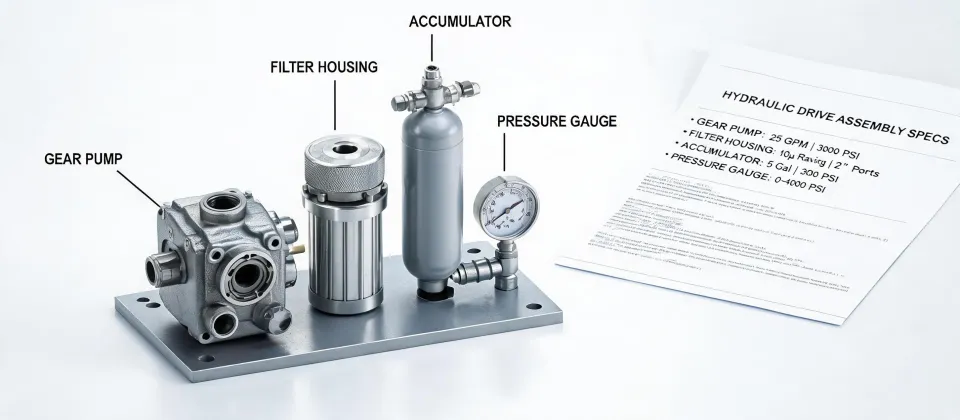
The carton sat on our receiving dock for two days before I opened it. Maybe I was busy. Maybe I was avoiding the suspicious feeling. When I finally cut the tape and pulled out the gear pump, I knew: the casting color was off. Not by much—maybe 10%, if I had to guess. But it was enough.
For context, I'm a quality/compliance manager at HYDAC. I review drive components before they reach customers—roughly 300 to 350 items a year, depending on load. I've been doing this since 2019. And starting in 2022, we began seeing a pattern that's honestly made me paranoid: gray-market parts labeled as genuine HYDAC equipment.
That pump, it turned out, was used. Someone had cleaned it, painted it, and stamped a new serial number in the wrong place. The performance curve didn't match the spec sheet. A HYDAC gear pump behaves predictably within a specific viscosity range. This one didn't.
Everything I'd read about the industry said counterfeiting was mostly a problem with filters and electronics. In practice, I found it's also happening with hydraulic pumps. The difference is a gear pump can look fine sitting on a shelf—until it starts under-delivering flow or, worse, sheds particles into your system.
The electric drive shift wasn't a revolution, but it was real
Around the same time, our repair department started getting more servo motor repair requests. Before 2021, most of our volume was pump- and valve-related. Then the mix shifted. By 2023, roughly one in five repair tickets involved an electric drive—a servo motor, a stepper motor, or a controller.
I don't say this to suggest the hydraulic world is dying. It isn't. Hydraulic gear pumps are still core to what we do. But machines today are increasingly hybrid: a hydraulic power unit might use a servo motor to drive the pump, with a stepper motor adjusting a valve position. That changed how I do quality checks.
It also changed how customers talk about failures. An operator will say "the pump is bad" when the actual problem is one of the servo motor controllers. Or they'll say "the motor is dead" when the stepper motor driver is out of sync. Servo motor controllers are the first place I look now when a hybrid machine acts up.
What's a stepper motor? A simple answer to a common question
There's a reason "what's a stepper motor" is such a frequent search. It's a simple concept, but it has real tradeoffs.
A stepper motor moves in discrete steps. It doesn't need an encoder to know where it is—the controller counts steps and assumes the motor follows. That's why a stepper motor can be cheaper and more robust than a servo motor in many applications. You don't need a feedback loop. For positioning a valve, moving a conveyor, or indexing a rotary table, stepper motors are often the right answer.
A servo motor, on the other hand, uses a feedback device—usually an encoder or resolver—to continuously verify position and speed. That closed-loop feedback makes it better at handling variable loads and delivering torque without losing steps. But it also means you have to pair the motor with a compatible servo motor controller, and the tuning has to be right.
Source note: According to NEMA MG 1, motor performance ratings assume specified operating conditions, such as ambient temperature and altitude. That's exactly the kind of detail that gets ignored when someone swaps a motor without checking the controller settings.
The servo motor repair that taught me more about misdiagnosis than motors
One job last spring stands out. A customer sent us a servo motor that had already been through two repair shops. The first shop replaced the bearings. The second shop replaced the encoder. The customer paid $1,800 for the first repair and maybe $2,200 for the second—I'd have to check the exact invoice, but it was over four thousand. The motor still wouldn't run reliably.
When our team opened it, the rotor assembly was fine. Bearings were fine. The encoder was fine. The real problem was a damaged cable connector on the servo motor controller side. Every time the machine vibrated, the controller lost feedback. The motor wasn't the issue at all.
That's not a knock on repair shops—some do excellent work. But it's an example of why quality checks need to look at the whole drive system. "Nothing is wrong with the motor" is not the same as "the system is healthy."
What I mean is: if you're sending a motor out for repair, ask the shop to verify the controller interface too. In that case, a $40 connector would have solved the problem. Instead, the customer spent thousands and lost a week of production.
Why the HYDAC industrial equipment reseller question keeps coming up
The gear pump incident changed our sourcing rules. If you're buying HYDAC components, you have two options: go direct, or use an authorized HYDAC industrial equipment reseller. The gray-market route is tempting because the price can be 10-15% lower. But we've seen the hidden cost: components stored in warehouses for years, condensation in the castings, seals dried out. On a gear pump, that's not cosmetic—it's a reliability risk.
I'm not saying every gray-market part is bad. That said, I've lost count of the times we've opened a "new" pump and found contamination inside the inlet port. According to ISO 4406, fluid cleanliness is coded by particle counts, and that contamination would already fail the standard. But until you connect a pump to a test rig, you don't know. Most plants don't have a gear pump test rig. So the reseller's verification process matters.
This isn't a HYDAC-specific problem—it's an industry problem. But for us, it's personal. We put our name on those components. When someone buys a HYDAC gear pump from a reseller who doesn't know or care about storage conditions, the failure is still a HYDAC gear pump failure in the customer's eyes. Reputation doesn't care which reseller you used.
What Actually Changed in My Job
It took me about four years and hundreds of hours on test benches to understand what the shift to electric drives really means. It's not "hydraulics are obsolete." The opposite is closer: hydraulics are evolving to work alongside electric controls.
A modern system can have a HYDAC gear pump supplying a hydraulic cylinder, a servo motor controller positioning the pump speed, and a small stepper motor adjusting a flow valve. The operating logic is no longer purely fluid-based—it's software and signals and feedback loops.
The fundamentals haven't changed. You still need contamination control. You still need proper alignment and torque. But the execution has transformed. In 2025, "quality" is not just checking a casting for hairline cracks. It's also checking whether the firmware in a servo motor controller is compatible with the drive's software.
If I had to distill this into one lesson, it would be: don't assume the component with the highest failure rate is the one that's broken. The most expensive failure I've seen in the last two years wasn't a failed gear pump. It was a misdiagnosis that led to a full motor replacement—when the problem was a loose wire in a connector.
That kind of mistake is avoidable with a proper system-level inspection. It's also avoidable if you buy through a supply chain that documents where a part came from. This worked for us, but our situation is specific: we're a global supplier with access to factory test data. If you're a plant engineer with one machine, your calculus will be different. Your mileage may vary—but I'd still start with the controller logs and the connector pins before replacing the big components.