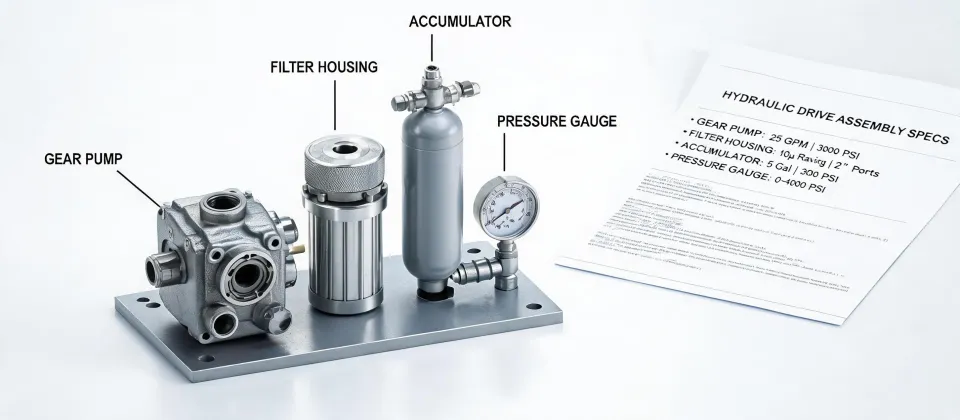
After six years of buying hydraulic and electric drive components—$180,000 in cumulative documented spend—I can tell you the most expensive part in any machine build isn't the servo motor, the filter element, or the gear pump. It's the rework. And most of that rework traces back to three fixable mistakes: ordering without reading the manual, guessing at encoder type on servo motors, and underestimating what a ball bearing actually carries.
Ten minutes of verification before hitting "submit order" has saved us an estimated $15,000 in restocking fees, return shipping, and installation rework. That's not a guess—I calculated it from our cost tracking system during a 2023 spending audit.
Why my numbers might look familiar
I'm the procurement manager at a 120-person industrial equipment manufacturer. We build and service custom hydraulic systems and electric drive trains, so my purchase orders run across HYDAC filter elements, gear pumps, and cartridge valves, plus servo motors, stepper motors, reducers, linear actuators, and bearings. I'm not a design engineer, and I don't pretend to be one. I'm the person who signs the POs, audits the invoices, and documents what happens when a part doesn't work the way it was supposed to.
Over the past six years, I've logged every order, every return, and every "can we fix this?" field ticket in our procurement system. I built a cost calculator after getting burned on hidden fees twice. What it taught me is that prevention is almost always cheaper than correction.
Read the HYDAC manual before you hit submit
From the outside, a HYDAC manual looks like 150 pages of technical noise: pressure ratings, port sizes, ISO 4406 cleanliness codes, element compatibility tables, torque specs. The reality is that each of those numbers is a boundary condition. Cross one and you're not just replacing a filter—you're explaining to a customer why their machine lost pressure at 2 a.m.
It's tempting to think you can just match the part number on the last purchase order. But HYDAC part numbers encode a lot: seal material, bypass valve setting, media rating, indicator options. I keep the HYDAC filter catalog PDF on our shared drive and I still double-check it before each order. The 30 seconds it takes to find the right page is nothing compared to the paperwork that follows a wrong part number.
We once ordered a return-line filter without checking the bypass pressure setting. The part looked right, fit right, and even flowed right—until a cold-start pressure spike opened the bypass and sent unfiltered oil through the system. The manual didn't hide that number; I just didn't look. What I mean is: the manual isn't just documentation, it's a spec sheet with expectations baked in. Treat it like one.
Stepper motor wiring: the "simple" part that isn't
Here's a classic surface illusion: a stepper motor with four wires looks dead simple. Wire it up, call it done. The reality is that stepper motor wiring is code, not just copper. The way you connect those wires tells the motor how to behave, and getting it wrong produces "mysterious" problems that are actually pretty predictable.
The big question is bipolar versus unipolar, and the difference isn't always visible from the outside. A 6-wire stepper can be wired as unipolar, bipolar half-coil, or bipolar series—each one changes torque and heating characteristics. And if the specification sheet doesn't match what the driver expects, the motor will run fine on the bench and fail under load. I've seen that pattern more than once.
I'm not going to pretend I read wiring diagrams better than our electrical engineers. But I've learned to ask one question before ordering: what wiring configuration does the driver actually support? That single question has prevented at least two "moderate" emergencies that would have each cost a week of installation rework.
Servo motor encoder: get this wrong and it's not "just a part"
People assume that buying a servo motor is about torque and speed. They don't see the encoder as a critical decision point—but the encoder type determines whether the motor can even talk to your drive. Incremental versus absolute, BiSS versus EnDat, resolution, commutation signals: these are not interchangeable. The cost of choosing wrong isn't the motor price. It's the downtime.
In Q2 2024, I almost ordered a servo motor with the wrong encoder. Our lead engineer caught it at the last minute: the drive required absolute feedback, and I was about to approve the incremental version to save $220. The restocking fee alone would have been $300, and the correct unit had a three-week lead time.
That $220 "saving" would have translated into roughly $2,000 in delay-related costs.
So glad our engineer asked before I hit submit. Since then, the encoder type is a required field on our PO template. If the engineer hasn't specified it, the purchase goes back to them. It slows things down by maybe an hour a month—and saves us from the kind of mistake that costs a week.
What's a ball bearing? A spec question in disguise
If you've ever asked "what's a ball bearing," the simple answer is: a set of steel balls between two concentric rings. That's true, but it ignores the part that matters for procurement—because two bearings can look identical and perform completely differently.
The numbers that matter are the dynamic load rating (C), the static load rating (C0), and the internal clearance class. The ABMA/ISO 15 tolerance classes—still commonly called ABEC 1, 3, 5, 7—matter for precision applications like servo motor shafts. A gear reducer output shaft is usually fine with ABEC 3; a high-speed spindle often needs ABEC 5 or better.
From a cost perspective, the "cheap" bearing that meets the dimensional spec but not the load rating will fail early. And when a bearing fails inside a gearbox, it takes the gearbox with it. I paid for that lesson once. That was enough. Oh, and don't assume "sealed" bearings are a safe default either—the grease type and temperature range vary, and a sealed bearing rated for a normal environment won't always handle a washdown application.
Where this approach stops working
All that said, verification isn't a magic wand. There are situations where you do everything right and still get surprised: extreme temperatures, heavy contamination, non-standard voltage, or design changes after the PO is placed. Manuals don't always cover every edge case. Take this with a grain of salt—my numbers reflect a 120-person operation, not a 20-person panel shop or a global OEM.
One more caveat: verification becomes less useful when the problem is genuinely novel—prototypes, first-of-kind integrations, or applications with no prior data. In those cases, testing beats checking. But for replacement parts and repeat builds, the manual plus a spec checklist is hard to beat. Prevention over cure isn't just a slogan—it's a budget line item.