-
Why We Had to Choose Between a Hydac Gear Pump and a Brushless DC Motor
-
The Comparison Framework: What We Actually Measured
-
Dimension 1: Upfront Cost—Closer Than You'd Think
-
Dimension 2: Installation—Where the Manual Actually Matters
-
Dimension 3: Energy—The Silent Budget Killer
-
Dimension 4: Maintenance—The Long Game
-
Dimension 5: Performance—Where the Servo vs. Pump Argument Gets Nuanced
-
What We Chose and What I'd Tell You
Why We Had to Choose Between a Hydac Gear Pump and a Brushless DC Motor
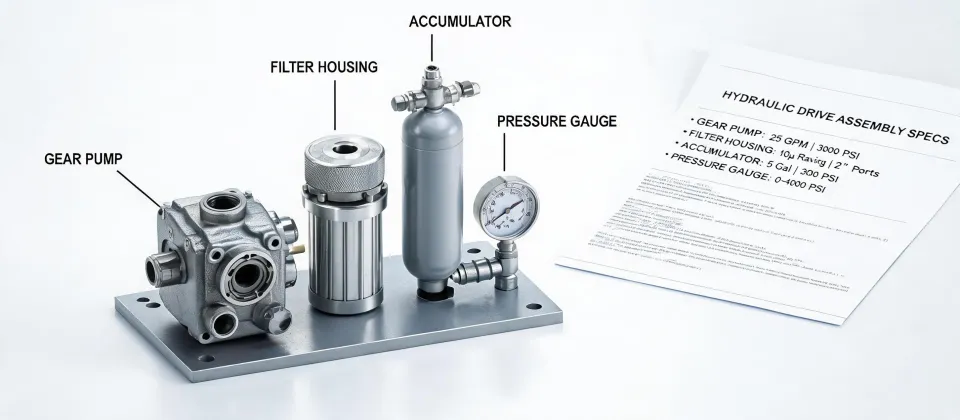
Last year we re-specified the drive train for a palletizing line. The old unit used a hydraulic motor driven by a pump we'd since discontinued, and the maintenance team was fed up with oil leaks. The obvious path was a Hydac gear pump—we'd run Hydac filtration for years, and the hydac manual for their pumps is one of the few documents our engineers actually read cover to cover.
But the plant manager wanted to explore electric actuation. A brushless DC motor with a planetary gearbox, running through a servo drive. He'd seen a similar retrofit at a sister plant. So for about two months, I did what I do best: tracked every cost line for both options.
This isn't a "hydraulic is dead" or "electric is the future" piece. In my opinion, that framing misses the point. What matters is your actual load profile, duty cycle, and how much downtime you can afford. Here's what the numbers said.
The Comparison Framework: What We Actually Measured
It's tempting to think you can just compare unit prices and be done. But identical specs from different drive technologies result in wildly different lifetime costs. I built a TCO spreadsheet with five lines:
- Acquisition cost (pump/motor, drive, controls, installation parts)
- Installation labor
- Energy consumption under our actual cycle
- Planned maintenance (fluid, seals, filters, lubrication)
- Unplanned downtime risk (estimated from failure history and spares availability)
We ran this for one specific machine: 22 kW equivalent output, 24/7 operation but an intermittent duty cycle—roughly 40% active, 60% idle.
Dimension 1: Upfront Cost—Closer Than You'd Think
On paper, the hydraulic option looked cheaper. A Hydac gear pump with a standard AC motor, a directional valve, a tank, and filters came to roughly $9,500 in component costs. The electric package—brushless DC motor, servo drive, gearbox, cables, and an e-stop relay—was around $12,800.
I almost stopped the comparison right there. Then I did what I've learned to do after getting burned on hidden fees twice: I asked "what's NOT included?" before accepting any quote.
We said "standard hydraulic package" to three vendors. They heard three different things—one included the tank, one didn't, and one assumed we had an existing power unit. We were using the same words but meaning different things.
The hydraulic quote assumed we had a central power unit to tap into. We didn't. Adding a standalone tank, pump-mount bell housing, pressure relief plumbing, and oil fill came to another $2,300—not including labor. The electric quote, by contrast, included everything: cables, connectors, and the programming software license. That's a 25% difference hidden in fine print.
The vendor who lists all fees upfront—even if the total looks higher—usually costs less in the end. Final installed price: $14,900 for hydraulic vs. $14,100 for electric. Almost a tie.
Price note: figures based on quotes we received in January 2025 from industrial suppliers, plus publicly listed catalog pricing. Excludes shipping; verify current rates before making your own comparison.
Dimension 2: Installation—Where the Manual Actually Matters
I assumed "same specifications" meant similar installation effort across technologies. Didn't verify. Turned out the difference was way bigger than I expected.
The hydac manual for the gear pump we evaluated specifies minimum straight-pipe lengths on the suction side, filtration requirements (they recommend a 10-micron return filter—and they make it themselves, go figure), and torque specs for mounting. All reasonable. But the physical work—mounting a 40 kg pump assembly, alignment with the electric motor, welding brackets, installing pressure gauges, bleeding the oil circuit—took two maintenance techs the better part of a week.
The brushless DC motor arrived as a single unit with a mating cable. The gearbox was pre-filled. The drive had auto-tuning. One tech mounted it in a morning; commissioning took the rest of the day. I'm not 100% sure of the exact hour breakdown, but we logged 28 person-hours for the electric install versus roughly 84 for the hydraulic. At our shop rate of $85/hour, that's a $4,760 difference.
Here's the catch: our situation was favorable. We had routing space for cables and no need for explosion-proofing. If you're in a dirty, high-vibration environment where a cable run would be exposed to damage, hydraulic lines might actually be quicker to route and protect. Your mileage may vary.
Dimension 3: Energy—The Silent Budget Killer
This had the single biggest effect on annual operating cost.
A Hydac gear pump is a fixed-displacement pump. When the motor runs at a set speed, the pump delivers full flow regardless of whether the actuator is moving. Excess goes over the relief valve or through the directional valve back to tank. That's wasted energy—but it's also heat the oil cooler has to reject.
We measured current draw on both systems over a real 10-day production cycle. The hydraulic system averaged 11.4 kW in operation, including idle periods when the AC motor kept spinning the pump. The brushless DC motor, with its drive in standby, drew under 500 W when the machine wasn't actively cycling. Over 5,200 operating hours per year, at $0.12/kWh, that's about $3,900 in annual savings for the electric drive.
If you ask me, energy cost is the line item most procurement teams ignore because it's not on the invoice—it's on the utility bill.
Dimension 4: Maintenance—The Long Game
Hydraulic systems have a lot of married components. Oil degrades. Seals wear. Filters clog. And here's a confession: we'd been replacing return filters on our other hydraulic machines every six months, not the 12 months suggested in the hydac manual, because our oil analysis showed particulate. Not Hydac's fault—our environment. But the maintenance cost is real: $180 per filter change, plus oil top-ups, plus the occasional seal kit.
The brushless DC motor's only planned maintenance is bearing greasing every 20,000 hours and periodic cleaning of cooling fins. That's it. The gearbox says "lifetime lubrication," which I take with a grain of salt, but it's still far less than the hydraulic annual service cost.
Over five years, I estimated hydraulic maintenance at about $6,200 in parts and fluids for this one machine, not counting labor. Electric was roughly $800.
I can only speak to our experience. We're a mid-size manufacturer with reasonably skilled maintenance staff. If you don't have someone comfortable with servo drive parameters, the electric option comes with a learning curve that's harder to quantify. The support team at the drive vendor matters more than the motor itself.
Dimension 5: Performance—Where the Servo vs. Pump Argument Gets Nuanced
A brushless DC motor gives you precise speed and position control natively. You can program acceleration ramps, hold torque at zero speed, and change motion profiles in software. The MG90S servo motor—a tiny hobby-grade servo we use for small diversion gates on one of our packaging lines—is a good example of how simple a servo application can be. It's a different world from an industrial servo, but the principle applies: if you need exact angular positioning, a servo is hard to beat.
Hydraulic power, on the other hand, is unbeatable when you need extreme force density. A gear pump driving a cylinder can generate tons of force from a compact package. The Hydac gear pump we tested was also more tolerant of shock loads.
This is where the "what uses a bevel gear" question comes in. You see bevel gears in both technologies—right-angle gearboxes on electric motors, and hydraulic drive units where the pump shaft needs to turn a corner. A bevel gear's job is simple: change the axis of rotation by 90 degrees. In our comparison, a right-angle planetary gearbox with bevel input let the brushless DC motor mount vertically in a space a hydraulic unit never would have fit. If you've ever had a delivery arrive and realized the motor's footprint doesn't fit, you know how much of a headache that saves.
What We Chose and What I'd Tell You
We went with the brushless DC motor for this particular line. The TCO difference—about $4,900 per year including energy and maintenance—was too big to ignore. But that's for a machine with intermittent duty and a clean factory environment.
Choose the Hydac gear pump if:
- Your duty cycle keeps the actuator moving most of the time (the energy waste shrinks)
- The environment has airborne dust or washdown that murders electronics
- You already have a hydraulic power unit with spare capacity
- Your maintenance team has more hydraulic experience than electrical
Choose the brushless DC motor if:
- Your cycle is intermittent with idle time (energy savings are massive)
- You need position or speed precision beyond what a simple hydraulic valve can deliver
- You're designing a new line and cabling is simpler than pipework
- Space is tight, and a right-angle bevel gearbox solves an orientation problem
The transparent-pricing lesson stayed with me, too. Get the vendor to list everything upfront. We found that the most "budget-friendly" hydraulic quote had $3,100 in items that weren't in the base price. The higher-priced electric quote included nearly all of it. That alone shifted the comparison.
Don't hold me to these numbers for your situation—our load profile, environment, and labor rates are specific to us. But the framework of comparing acquisition, installation, energy, maintenance, and performance across your actual cycle? That works for any drive technology decision. Run the spreadsheet before you trust your gut.