I'll say it plainly: unit price is the worst way to buy industrial equipment. That sounds strange coming from a procurement person—our whole job is watching cost. But after tracking roughly $180,000 in annual purchasing for over six years, documenting every order in our cost tracking system, I know exactly where the real costs live. And they don't live on the first line of a quote.
The purchase price is just the number at the top of the invoice. The total cost of ownership—TCO, i.e., everything that happens after the part arrives: installation, energy, maintenance, downtime, and the cost of failure—is the story that matters.
I've built my TCO framework the hard way: a ball bearing that failed, a filter catalog I should have read sooner, and an induction motor quote I almost got wrong. These three examples shaped how I evaluate every purchase I approve.
What's a Ball Bearing? Apparently a $2,300 Lesson
Let's start with the smallest part in this story. If you're not a mechanical engineer, you might ask: what's a ball bearing? It's a precision component that lets a rotating shaft spin smoothly. Steel balls roll between an inner and outer race, carrying the load with rolling friction instead of sliding contact. It's a simple concept, but manufacturing tolerances are what separate a reliable bearing from a premature failure.
In early 2024, I compared two quotes for the same bearing series—same dimensions, same rated load on the spec sheets. One vendor offered $3.80 per unit. The other offered $12.40 per unit. The cheaper quote came from a trader we'd never used. The higher quote came from our regular distributor, which is a HYDAC industrial equipment reseller. We needed the bearings quickly. The budget check was painless. I signed the $3.80 purchase order.
Eleven weeks later, one of those bearings seized in a 22 kW fan motor.
Here's what the replacement actually cost, pulled straight from our tracking system: the emergency bearing order itself ($280 with expedited shipping), the motor rewind ($1,100), and two maintenance techs pulled off their planned work. We logged six hours of unplanned downtime on the line. Total direct cost: roughly $2,300. For a part that had saved us a grand total of $8.60 per unit.
Of course, I didn't see it that way at the time. When the bearing failed, my first instinct was to blame the motor, then the maintenance schedule, then the operator. But the evidence in my own cost tracking system was unambiguous. Up to that point, our annual spend on that bearing series was $360. The failure cost more than six times that amount.
Seeing the cheap bearing and the premium bearing side by side in my year-end cost report made me understand the difference in a way no seminar ever had. Both spec sheets listed an ISO 281 fatigue life rating. The $3.80 bearing's L10 rating—the calculated operating hours at which 90% of tested bearings will still run—was about a third of what the $12.40 bearing offered. The data was right there. I just hadn't read it.
The HYDAC Filter Catalog Isn't Glamorous—It's Just Math
My second lesson came from filtration. Specifically, from the HYDAC filter catalog.
I'll be honest: I spent my first few years in procurement treating filter catalogs as shelf decor. Then a senior maintenance engineer sat me down and walked me through the HYDAC filter catalog like a maintenance manual. I wish he'd done it in my first month.
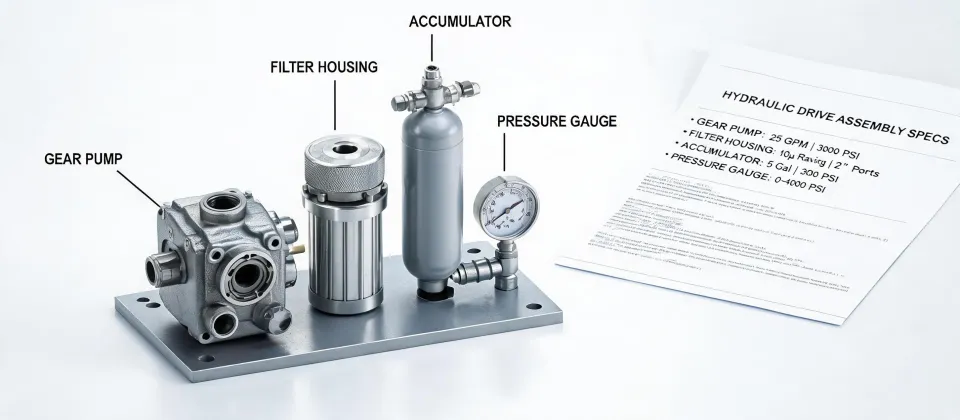
Here's the logic, as I now explain it to our plant managers. Hydraulic systems fail when the oil gets contaminated—not because the pump "got old." The filter element keeps the oil clean. The HYDAC filter catalog tells you exactly which element goes in which housing, what micron rating your system needs, when to change it, and what the pressure drop curves mean. It reads like stereo instructions (unfortunately, because the content is genuinely important), but the economics are simple: a $60-120 filter element protects a $1,500-3,500 gear pump, and it also protects the cartridge valves downstream that cost $200-600 each.
When I audited our 2023 spending, I found that most hydraulic component failures happened on machines where someone had substituted a generic "compatible" filter element to save a few dollars per change. We switched back to the genuine elements through our HYDAC reseller, tightened the service intervals, and pump-related downtime dropped by about half the following year. I remember the moment clearly: my spreadsheet showed that repair costs for hydraulic systems had fallen roughly 40% from the previous year, and the only variable that changed was the filter sourcing. Same machines, same operators, same maintenance crew. The hardware didn't change. The cost of the consumable went up by maybe $300 per year per machine. The repair costs went down by thousands.
I don't have hard data on industry-wide failure rates, but based on six years of our own order history, the pattern is unmistakable.
Induction Motors: The 10-Year Cost Nobody Calculates
Then there's the bigger equipment: induction motors. An induction motor uses electromagnetic induction to convert electrical energy into rotational force—no brushes, no commutator, just a rotor spinning inside a stator. It's been the backbone of industrial motion for over a century, and it's almost always ignored in procurement conversations until one burns out in the middle of a production run.
The assignment that changed my thinking was an induction motor furnace application—a replacement motor for the air blower on one of our heat-treatment furnaces. Furnace duty is brutal: high ambient temperature, radiant heat off every surface, and zero tolerance for unplanned stops.
The quotes came in with a 30% spread. The cheaper motor was built for standard industrial duty. The more expensive one was designed for furnace duty: higher insulation class, higher service factor, sealed bearings rated for heat. Both were induction motors in the same frame size with the same kW rating. The difference only showed up in the spec sheets.
I asked our electrical engineer to run a 10-year TCO comparison. Per IEC 60034-30-1, the efficiency difference between motor classes at this rating is typically 2-3%. On a 37 kW motor running 6,000 hours per year, that's roughly 22,000 kWh per percent, per year. At industrial rates of $0.08-0.12/kWh, the energy penalty is $1,800-2,600 annually. Over a decade, the higher-efficiency motor is $18,000+ cheaper in electricity alone—before factoring in a single breakdown.
The risk calculation made the decision obvious. Upside of the cheaper quote: about $800 in one-time savings. Downside: another emergency failure on a furnace line, with probable total costs of $5,000-15,000 depending on collateral damage. I kept asking myself: is $800 worth potentially shutting down the furnace line for a week? No. Not close.
But the Budget...
I can hear the objection: "Easy for you to say when you have budget to spare." That's exactly backwards. TCO thinking matters most when your budget is tightest—because when you can't absorb failures, you can't afford parts that might fail.
The other objection I hear is about the supply chain: "Why not buy direct and skip the reseller margin?" I understand the temptation. But a HYDAC industrial equipment reseller isn't just a middleman. They maintain the filter catalog cross-references, they have application engineers who catch mismatched specs before you order them (which has saved us more times than I can count), they handle warranty claims without a month of email ping-pong, and they're the ones who get a replacement part on a truck when we genuinely can't wait. In procurement terms, their margin is an insurance premium against the far larger cost of the wrong part arriving on a Friday afternoon.
My Bottom Line
I still review every invoice, and I still push back on prices. That's my job. I've just stopped pretending that paying less is the same as costing less.
As of early 2025, based on six years of our internal procurement records, this is what works for us: spec for the actual operating condition, source through a traceable channel, and calculate the TCO before signing anything. The market changes. Prices move. The numbers will differ at your plant. The logic doesn't.
Paying less is not the same as costing less.
That $3.80 bearing cost us $2,300. I'm writing this so it costs you nothing.