-
1. Copy the motor nameplate, not the old PO
-
2. Check the dimensions that aren't on the spec sheet
-
3. Know how VFD control motor speed affects your motor choice
-
4. Confirm the real lead time and pay for certainty when it matters
-
5. Verify the vendor can send a proper invoice before you buy
-
6. Use the HYDAC catalog PDF, but make sure it's current
-
Final checks before you send the PO
I'm the office administrator for a 145-person manufacturing plant. I handle all the maintenance and production supply ordering—roughly $1.1 million a year across 12 vendors. I report to operations and finance, which basically means I'm the one who gets asked why the line is down, then asked why the invoice doesn't match the quote. Both are fair.
If you buy induction motors, hydraulic filters, gear pumps, or other industrial parts for a living, you know that small ordering mistakes become expensive fast. This checklist is for people like me: not engineers, not procurement specialists, just whoever owns the PO and needs it to be right. I've been doing this since 2020, and after 200+ orders, these are the checks I won't skip.
Before I get to the steps, one mindset shift. Everything I'd read about purchasing said to get three quotes and pick the cheapest. In practice, after hundreds of orders, I've found the cheapest quote often costs more after returns, expedited shipping, and invoice errors. The vendor who answers the phone and sends the right paperwork is worth a few dollars extra. That's the assumption behind this checklist.
1. Copy the motor nameplate, not the old PO
For induction motors, the nameplate is the only description that matters. It includes voltage, full-load amps, horsepower, frame size, RPM, enclosure, and service factor. A parts list from 2019 that says 'same motor' isn't enough.
Take a photo of the nameplate and save it with the purchase request. I know that sounds obvious, but in 2021 I ordered a replacement gear motor from an old line item and skipped the nameplate. The motor had been rewound at some point, and the frame was different. It didn't fit. Now the photo goes into the order notes automatically.
One detail almost everybody ignores is the duty rating. If the motor is rated for intermittent duty and your process runs 24/7 in a warm area, that's a red flag no matter how good the price is. Also check the service factor. A 1.15 service factor motor can handle occasional overload; a 1.0 cannot. Replacement listings often don't show it.
2. Check the dimensions that aren't on the spec sheet
Frame size gets you close, but it won't tell you shaft diameter, keyway width, terminal box location, or whether the feet are tapped. This is the step most people skip, and it's the one that causes returns.
Frame suffix matters too. A C-face motor and a foot-mounted motor can share the same frame number, but they are not interchangeable. If you're replacing a Century AC motor, don't assume every motor with the same HP and RPM mounts the same. I've seen a replacement with the same frame size but the terminal box on the opposite side, so the conduit didn't reach. Rotating the body fixed that, but then the drain holes pointed up. That kind of issue doesn't show up on a website's cross-reference table.
Write down the shaft height, shaft diameter, and mounting pattern. If you can, measure the actual motor body. A small difference in terminal box orientation can become an extra hour of labor next time the motor fails.
3. Know how VFD control motor speed affects your motor choice
If you need variable speed, the motor and the variable frequency drive have to be compatible. For anyone asking how VFD control motor speed works, the short version is: the drive changes the frequency and voltage going to the motor, and the motor's speed changes roughly in proportion to the frequency. The relationship is defined in NEMA MG 1, so it's not a vendor preference.
Why it matters for purchasing: a standard motor can overheat when a VFD runs it at low speed for long periods, because the shaft-mounted cooling fan slows down too. So look for 'inverter duty' or 'VFD rated' on the nameplate. If you're putting a new drive on an existing Century AC motor, ask the vendor to check winding insulation and cooling before you buy.
This is honestly the area where I'm happiest to lean on the supplier. I know enough to ask 'is this motor VFD rated?' and 'what is the minimum speed?' If they can't answer both, I find another supplier.
4. Confirm the real lead time and pay for certainty when it matters
The published lead time is often for a motor sitting in someone's warehouse. If it isn't in stock, the real lead time is whatever the factory says. I've learned to ask two separate questions: 'Is this in stock in the US?' and 'If not, what is the manufacturer's confirmed week?' Ask whether that date includes freight and testing. Sometimes 'lead time' means the motor is ready at the factory, not on your dock.
This is where I now pay extra for certainty. The failure in March 2024 changed how I think about lead times. A conveyor motor died on a Thursday. Our regular supplier quoted $1,900 and a 10-day lead. A different vendor had the same motor available in another state for $2,300 and could get it to us in three days. I paid the extra $400 without approval. Missing the following week's production run would have cost more like $15,000.
Bottom line: rush charges are not a waste. They buy a guaranteed date. When downtime is on the line, 'probably on time' is the most expensive phrase in industrial purchasing.
5. Verify the vendor can send a proper invoice before you buy
In 2022, I found a good price on hydraulic filters from a new supplier, about $300 less than our normal vendor. The filters arrived fine. The invoice was a handwritten receipt on a notepad. Finance rejected it, and I ended up eating the cost from the department budget. That's how I learned that a low price only matters when the paperwork is accepted.
Before the first order, ask for a W-9 and a sample invoice. If they can't show you a clean, tax-compliant invoice, or a commercial invoice for international shipments, that's a deal-breaker. I don't care how good their equipment looks.
6. Use the HYDAC catalog PDF, but make sure it's current
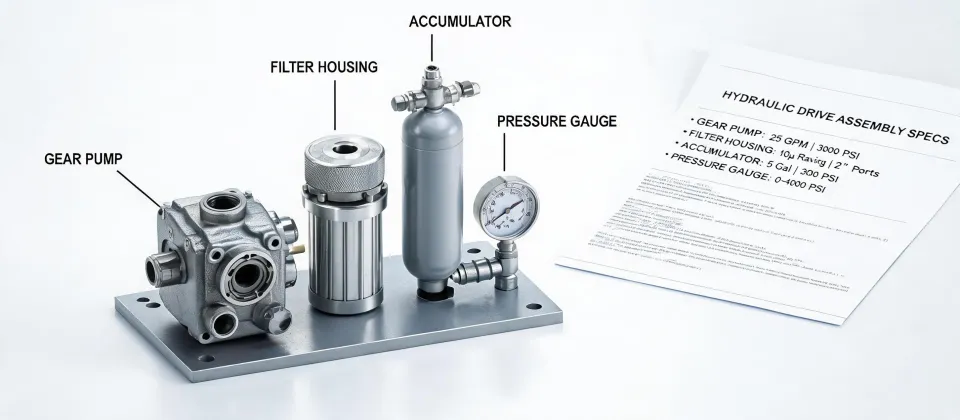
A lot of our hydraulic filtration is HYDAC, so I spend more time than I'd like looking up filter elements, gear pumps, and cartridge valves. The HYDAC catalog PDF is a genuine resource for that—part numbers, dimensions, cross references. But don't use an old copy. Part numbers get superseded. I've nearly ordered a filter element that was replaced four years ago, and the distributor caught it before shipping.
Search behavior matters, too. If someone types 'hydac buy industrial supplies' into Google, they get a mix of authorized distributors, marketplaces, and look-alike sites. I prefer to start with the official catalog or a distributor I already use. That solves both the compatibility problem and the invoice problem.
Final checks before you send the PO
- Nameplate photo and duty rating are confirmed.
- Shaft, mounting, and terminal box position are verified.
- VFD compatibility is confirmed in writing if applicable.
- Lead time is guaranteed, not estimated.
- Vendor can provide the paperwork finance will accept.
- You're using the current catalog and a verified supply channel.
I'm not a motor engineer, so I can't help you with torque curves or sizing calculations. What I can tell you from the purchasing side is that most order problems are not math problems. They're detail problems—the things we skip because we're busy and the price looks fine. Run this checklist before every induction motor or industrial part order, and you'll make fewer expensive mistakes.
If that sounds boring, good. Boring is what we want in procurement.