I Almost Signed Off on the Wrong Reducer
Last March, a distributor walked into our inspection bay with a sample gearbox that looked, on paper, completely reasonable. The drawing said 'worm gear reducer.' The application was a packaging-line conveyor with the motor and conveyor shaft running parallel, maybe 200 mm apart. The customer's hydraulic system already included a HYDAC gear pump for lubrication and a cartridge-valve manifold for pressure control. My job was to review the proposed reducer before it went into their quote.
One look at the shaft arrangement told me something was off. To be fair, a worm gear reducer is not a bad component. It's compact, it can deliver a high ratio in a single stage, and it handles shock loads without complaining too much. But it is a right-angle device. The input and output shafts sit at 90 degrees to each other. On a conveyor where the motor shaft is parallel to the drive shaft, that geometry alone should have been a red flag.
The distributor's next suggestion was a straight bevel gear. That's a better choice when you actually need a 90-degree turn: the teeth are straight, cut on conical blanks, and the shafts intersect. But it still didn't solve the problem. The application was not asking for a right-angle drive. It was asking for a simple parallel-shaft reduction.
The Question That Finally Made It Click
Somewhere in the middle of that conversation, a younger engineer asked me, 'Which gear is most likely to use a spur gear?' I laughed, because it sounded like a textbook question, but it's actually the right question.
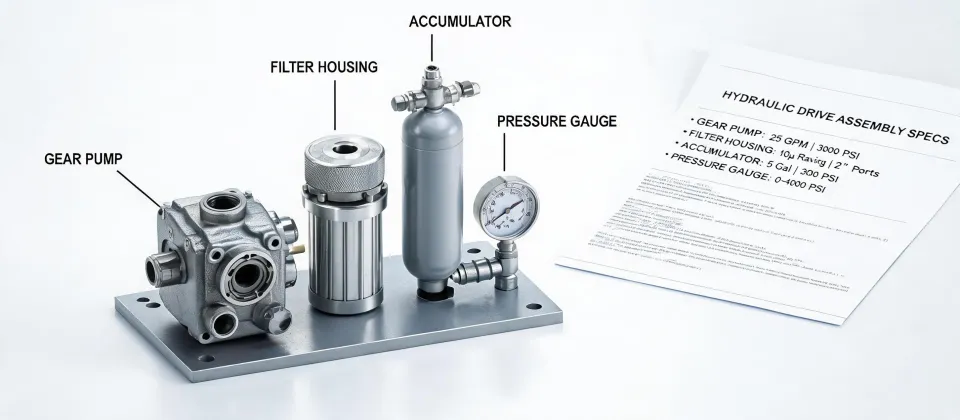
In my experience, the most likely candidate is a gear pump. The basic idea is simple: meshing gear teeth trap fluid between the teeth and the housing and carry it from the inlet to the outlet. Many gear pumps use spur gears because they're efficient, easy to manufacture, and perfectly fine for fixed-displacement duty. HYDAC's gear pump range follows the same principle, though the tooth form depends on the series—some use spur teeth, some use helical teeth for quieter operation.
If the question means 'which application is most likely to use a spur gear,' I'd answer the same way. Parallel shafts, moderate speed, continuous duty, and a need for efficiency. That's where a spur gear is the right baseline. It has no axial thrust, the tooth geometry is simple, and the cost is usually lower than a comparable helical or bevel set.
What the Test Bench Told Us
We didn't argue much after that. Instead, we set up a quick comparison in the test bay. Not a full lab certification, more like a sanity check. We ran a straight bevel gear, a worm gear reducer, and a parallel-shaft spur gear unit under similar loads. The HYDAC gear pump supplied the oil flow for the rig, and a pressure-relief manifold kept the test pressure steady.
I also pulled out the HYDAC cartridge valve catalog while we were at it. Not because we needed a new valve, but because it's a good example of how to document technical decisions. You choose a valve by pressure drop, flow rating, and envelope, not just by port size. Gear selection should work the same way: ratio, shaft arrangement, duty cycle, efficiency, and noise budget.
The results were pretty clear. The worm gear reducer was convenient from a mounting standpoint, but its efficiency was noticeably lower. At the ratio we needed, running continuously, it generated a lot of heat. Don't hold me to the exact numbers—we didn't certify the rig—but the temperature rise was hard to ignore. The straight bevel gear was mechanically strong, but noisier, and it wasn't designed to give us 15:1 in a single stage. A multistage bevel unit would have been heavier and more expensive than anything the customer needed.
The spur gear unit was, honestly, the boring answer. And 'boring' is a compliment in my line of work. It gave us the ratio, the parallel shafts, high efficiency, low noise, and fewer things to go wrong. The surprise wasn't that the spur gear won. The surprise was how close we came to ordering the wrong component because the first data sheet looked fine.
A Quick Rule of Thumb
If you're in a hurry, use the same shortcut I use when I look at a new gearbox.
- Parallel shafts and continuous duty? Start with a spur gear. If noise is a problem, look at helical gears.
- Shafts at 90 degrees and intersecting? A straight bevel gear is the conventional choice.
- Right angle, high ratio, compact envelope? A worm gear reducer might be the right fit—just budget for lower efficiency and more heat.
Which Gear Is Most Likely to Use a Spur Gear?
Bottom line: if the motor shaft and the driven shaft are parallel, and you need a simple, efficient, reliable speed reduction, the answer is almost always a spur gear. That's why gear pumps use them. That's why countless industrial reducers use them. A straight bevel gear is for intersecting shafts, usually at 90 degrees. A worm gear reducer is for right-angle drives where a high ratio and compact size matter more than efficiency.
Granted, there are exceptions. If noise is a critical requirement, helical gears are often a better option than spur gears. If you need a very high ratio in one compact right-angle package, a worm reducer can earn its place. But the question was 'which gear is most likely to use a spur gear?' and the honest answer is: the one that doesn't need a right angle.
What I Learned From a Near-Miss
That order never went out. We sent the customer a revised proposal with a parallel-shaft spur gear reducer, and the system went into service without a problem. So glad we caught it in the review. It would have been an expensive install, and worse, an expensive removal.
One more thing. It took me several years and a few uncomfortable field failures to understand that gear selection is mostly about geometry and duty cycle, not peak torque. Anyone can calculate a torque number. The hard part is asking, 'What is the shaft arrangement, and how long will this thing run?' Wrong shaft angle. End of story. A lesson learned the hard way.
My experience here is based on hydraulic and industrial drive inspections in the 5–250 kW range. If you're working on precision robotics or aerospace drives, take my story with a grain of salt—those applications have different rules. But in fluid power and industrial machinery, the pattern is consistent: when in doubt, check the shaft angles first. Everything else follows.
I'd also say this: I'd rather tell a customer this is outside my review scope than pretend to know a gear type I don't. The supplier who says 'this isn't our strength—here's who does it better' earns trust for the next job. That's not weakness. That's professional respect. And it's the same reason I keep going back to the catalogs, including our own HYDAC cartridge valve catalog, when I need to check a rating instead of guessing.