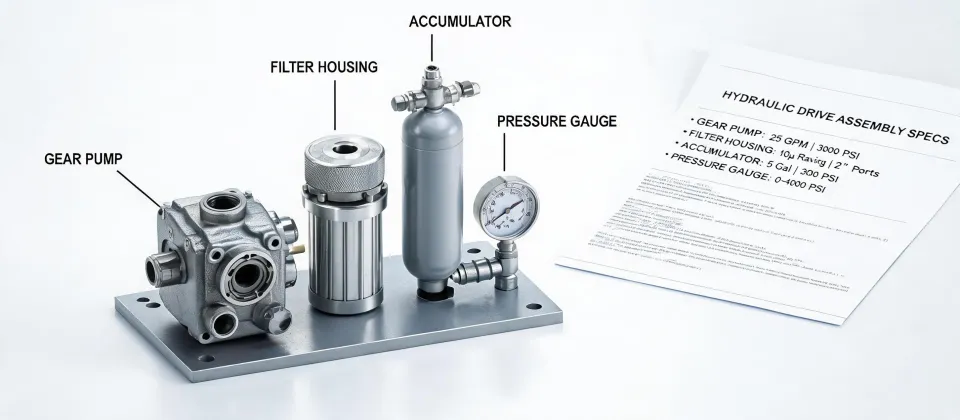
If you're sourcing HYDAC industrial parts, here's the short version before the long version: the money isn't in the unit price. It's in the specification. The right filter class, the right valve electric actuator torque, the right motor type. Get those right once, and the total cost over the life of the machine beats anything you'll get from shopping around for the lowest number.
I've been a procurement manager at a mid-sized machinery builder for six years. I manage roughly $180,000 a year in hydraulic and electric drive components, and I've audited every dollar we've spent on them since 2019. In 2023, I watched a $4,200 electrical actuator purchase turn into a $12,000 project because we skipped the part where you verify the fail-safe mode. That one mistake is now the reason I check specs before a purchase order goes out.
Why the HYDAC Filter Catalog Is a Budget Document, Not a Menu
When I open the HYDAC filter catalog, I'm not looking for the cheapest element. I'm looking for three numbers: filtration rating, beta ratio, and pressure drop over the element's life. Those three numbers determine whether the filter will keep the oil clean enough to protect the pump and valves downstream. If a system needs ISO 4406 cleanliness code 18/16/13 and I buy a filter with a lower beta ratio at the same micron size because it's cheaper, the oil might look clean for a week. After that, the element loads up, the bypass valve opens, and the filter stops filtering.
What most people don't realize is that a filter is a pump's insurance policy. You may not see the damage for months, but every particle that gets through accelerates wear in ways that show up in the annual maintenance budget, not on the original invoice.
Here's something vendors won't tell you: generic replacement filters can look identical to the OEM part and still fail you in the field. Same thread, same length, same micron rating on the box. But if the collapse pressure or bypass valve setting is different, the filter is not the same part. The HYDAC filter catalog lists these values for a reason. When I compare vendors, I'm not comparing boxes. I'm comparing the test conditions behind each part number.
Skipped the ISO code check on a skid we were building because 'the customer's machine has been running fine for years.' It hadn't. The oil was already loaded with varnish. The new filter plugged in three weeks instead of six months. We paid for an emergency swap, an oil flush, and a phone call nobody on our team wants to repeat. That's the moment I stopped treating filter specs as optional.
I also pay attention to where HYDAC industrial parts come from. Buying through a distributor who can provide lot traceability gives us documentation: batch records, inspection certificates, and a clear path back to the manufacturer. Gray-market parts lose that paper trail. When something fails, the paper trail tells you whether it was a design issue, an installation issue, or a manufacturing issue. Without it, you're guessing.
Valve Electric Actuators: Torque Margin Is Your Insurance Policy
The biggest budget killer I see in valve automation isn't the purchase price of the actuator. It's the mismatch between the actuator's rated torque and the real-world torque of the valve. A new valve can have higher packing friction than the valve data sheet suggests. If you buy an actuator with exactly enough torque, you'll get a valve that sometimes doesn't open or close. That leads to a service call, lost production, and a second actuator purchase.
I've compared maybe 60 actuator quotes over the last five years. No, probably closer to 80. One pattern is consistent: the cheapest quote is the one that gets submitted early in the process, before anyone checks torque margin. Now I require at least 25% torque margin on every electric actuator we spec, and 30% on high-cycle applications. That's a rule I stole from a pump supplier who had been burned the same way.
Another spec that gets skipped: fail-safe position. When power is lost, should the valve open, close, or stay where it was? If nobody writes it into the part spec, you'll get whatever the spring defaults to. That can be dangerous on a hydraulic pressure line and expensive on a cooling line. Deciding this before you choose the actuator costs no money. Deciding after installation costs a second actuator plus labor.
What's a Servo Motor? (And When Should You Pay for One?)
Let's answer the easy part first. A servo motor is a motor combined with a feedback device—usually an encoder—and a controller that closes a loop on position, speed, or torque. The controller compares the actual position to the commanded position and adjusts current to the motor continuously. That feedback loop is what turns a motor into a servo.
A brushless AC motor without feedback is just a motor that spins when you give it power. It's reliable, inexpensive, and ideal for fans, pumps, and compressors. But if you need precise speed control, indexing, or torque control, a servo motor is worth the premium. The price difference can be large, and paying it when you don't need to is waste.
I've seen a $500 motor kill a $15,000 machine's throughput because it couldn't hold position. I've also seen a $2,500 servo system used to drive a fan that would have been perfectly happy with an $800 brushless AC motor and a VFD. The right choice depends on the control loop you actually need.
In practice, many modern servo motors are brushless AC motors with feedback and a drive. The line is blurry. The distinction that matters for your budget is whether your application requires position feedback. If it does not, a standard brushless AC motor is usually the smarter buy.
Where Over-Specification Wastes Money
Prevention does not mean buying the most expensive thing in the catalog. Over-specifying is the other side of the same mistake. If you're running a simple lubrication circuit with acceptable particulate levels and easy access for filter changes, a high-efficiency microglass filter might cost more to buy and replace without adding value. The goal isn't to buy the best product in the HYDAC catalog; it's to buy the exact specification that prevents the predictable failure.
In my cost tracking spreadsheet, I classify every part purchase as either planned replacement or reactive repair. The ratio is what matters. When we switched to correctly specified filters and actuators, the reactive repair share dropped from about 30% of the maintenance budget to roughly 12% over the following year. That's my own number, not a published statistic, and I'd have to check the exact figures to quote them more precisely. But the direction is clear: prevention is what moves the ratio.
The Cost Controller's Checklist
If you're putting together a HYDAC order this quarter, here's the checklist that works for me:
- Confirm the ISO 4406 target for your hydraulic system before choosing a filter.
- Check the filter's beta ratio and pressure drop, not just micron rating.
- Verify the valve electric actuator has at least 25% torque margin, or 30% for high-cycle service.
- Write the fail-safe position into the spec: open, closed, or last position.
- Ask whether your application needs the feedback loop that makes a servo motor a servo motor. If not, consider a brushless AC motor with a VFD.
- Buy from a source that provides a real paper trail for HYDAC industrial parts.
That's the whole secret. It's not clever. It's just prevention. And prevention is the cheapest thing I buy.