- The Two Options on the Table
-
Dimension 1: Upfront Price—and the Fine Print
-
Dimension 2: Control and Precision
-
Dimension 3: Maintenance and Supplier Accountability
-
Dimension 4: Total Cost of Ownership—Rough Numbers
-
The Verdict? It Depends—But Not in the Annoying Way
-
Buying Advice From a Buyer
-
Final Thought
Back in 2020, when I first took over purchasing for our machinery shop, I had a simple rule: pick the lowest quote and move on. That rule lasted until a $200 savings turned into a $1,500 problem. Since then, I've learned to compare systems, not just price tags. I'm an office administrator for a 60-person company, and I manage roughly $400,000 a year in MRO orders across 12 vendors. I'm not a design engineer—I'm the person who signs the purchase orders. This article is written from that seat.
In our 2024 vendor consolidation project, we had to choose between two ways to power a new indexing station: a HYDAC hydraulic package or an electric system built around a hybrid stepper motor. Both proposals looked reasonable. Both vendors promised good support. But the two systems are not interchangeable, and that's the point.
The Two Options on the Table
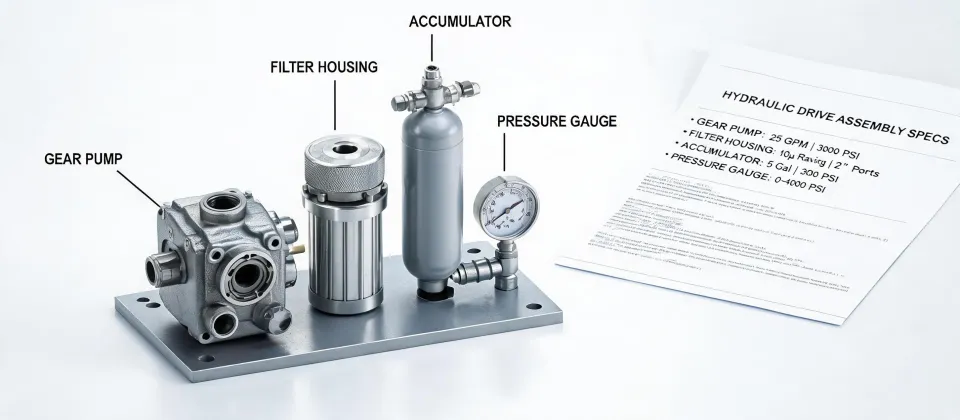
The hydraulic quote came from a local HYDAC industrial equipment reseller. They provided a complete package: gear pump, filter, manifold, cartridge valves, hoses, and a written installation guide. I checked the HYDAC catalog and confirmed the part numbers, flow ratings, and pressure specs before considering the price.
The electric quote used a hybrid stepper motor with a motor shaft coupling, a driver, and a screw-driven linear actuator. It looked simpler, and it was cheaper upfront. But I had to ask myself: do I actually understand what a stepper motor is?
What's a Stepper Motor? (A Short Answer)
If you're searching that phrase, you're not alone. I had to look it up when the proposal landed on my desk. A stepper motor is a brushless electric motor that rotates in fixed increments called steps. A hybrid stepper motor combines a permanent magnet rotor with a variable-reluctance stator. That combination gives finer step resolution and better torque than a basic permanent-magnet stepper. In full-step mode, most hybrid steppers take 200 steps per revolution—1.8 degrees per step. With microstepping, the drive divides each step further, which smooths the motion.
The motor shaft coupling, in this setup, is the small component that connects the motor shaft to the leadscrew. It seems like an afterthought. Until it isn't.
Dimension 1: Upfront Price—and the Fine Print
The electric proposal was 12% lower: $7,150 versus $8,200. If I had compared only those two numbers, I would have stopped there. But I've been through the 'cheap purchase, expensive lesson' cycle before. In 2022, a vendor offered me a great price on a component. They couldn't provide a proper invoice. Finance rejected the expense report, and I ate $2,400 out of the department budget.
So I asked both vendors to list everything that wasn't in the quote. The HYDAC reseller already had it itemized. The electric vendor hadn't included the motor shaft coupling—that was another $95—and didn't mention the programming time for the driver until I asked.
None of those numbers are huge on their own. Add them up, and the gap shrinks. The point isn't that one side was hiding costs. The point is that you can't see the true price until you see the full scope.
Dimension 2: Control and Precision
For precision positioning of a light load, the hybrid stepper motor is hard to beat. The driver sends electrical pulses, and the motor moves a defined number of steps. That's open-loop control. If the load is predictable, it's simple and repeatable. If the load spikes, the motor can miss steps. And unless you add an encoder, no one knows.
Hydraulic motion is different. A HYDAC gear pump and cartridge valve system can generate high force without the same worry about stalling. You can control speed with flow and force with pressure, and a hydraulic cylinder can hold position under load. But you also need a power unit, tank, filter, hoses, and proper oil maintenance. More components, more leak paths, more things to check.
The surprising conclusion—at least to me—was that the stepper motor actually produced more consistent positioning in the indexing application. The hydraulic system's repeatability depended on oil temperature and contamination levels. The hybrid stepper motor just did what the controller told it to do. Boringly consistent. In production, boring is good.
Dimension 3: Maintenance and Supplier Accountability
This is where the HYDAC catalog earns its keep. The 2025 HYDAC catalog lists filter element part numbers, micron ratings, pressure ratings, and even ISO 4406 contamination classes. When a filter element or cartridge valve part number is printed in the catalog, you can order the exact replacement, every time. The HYDAC industrial equipment reseller recorded serial numbers, provided recommended spares, and told us which seal kits to stock. That documentation is worth real money when the machine is down.
The stepper motor market is less standardized. There are excellent manufacturers with published torque curves and wiring diagrams. There are also unbranded imports with vague specs. Most hybrid stepper motors follow NEMA frame sizes, so the mounting pattern is predictable. But the electrical and software behavior is not. If you buy a hybrid stepper motor and driver from different sources, troubleshooting gets messy. I've been through that, too—same words, different meanings. We once ordered a 'standard' motor shaft coupling and got one with the wrong bore size. We didn't mention bore size because we assumed 'standard' meant something. It didn't.
Ask the electric vendor for the motor's torque curve, phase resistance, and step angle. If they can't provide those, treat the part as unproven.
Dimension 4: Total Cost of Ownership—Rough Numbers
Here's the math I did for the five-year cost. It's not a rigorous engineering study; it's the kind of estimate a buyer uses to challenge a proposal. Quotes are from February 2025.
- HYDAC hydraulic package: $8,200 initial + roughly $900 per year for oil, filters, seals, and energy = about $12,700 over five years.
- Hybrid stepper motor system: $7,150 initial + $95 motor shaft coupling + roughly $450 per year for bearings, alignment checks, and energy = about $10,450 over five years.
On paper, the stepper system looked about $2,250 cheaper. My gut said there was a catch. The catch was the failure mode. If the stepper motor stalls, the motor shaft coupling is the first thing to fail. That's a small replacement part. But if the screw drive takes the hit, the repair bill is different. The hydraulic system was less sensitive to that particular jam.
Then the electrician pointed out that the plant already had a 480 V hydraulic power unit on another station. Sharing it would reduce the HYDAC package cost by about $1,500. That changed the comparison.
The Verdict? It Depends—But Not in the Annoying Way
We bought both systems. The HYDAC package went on the high-force clamping station. The hybrid stepper motor system went on the lower-force indexing table.
That sounds like a non-answer, but it's not. The original question was 'Which one is better?' The right question is 'Which one is better for this specific job?' The clamping station needs force and fail-safe holding. The indexing table needs fast, repeatable positioning. They are different tasks.
The more expensive quote won one of the two because it came with traceability and support. The cheaper quote won the other because it was simpler, accurate, and easier to maintain. That's what value over price actually looks like.
Buying Advice From a Buyer
- Ask for the catalog. For HYDAC, the product catalog is the source of truth. If a reseller can't provide part numbers and specs, find another reseller.
- Ask what happens after the sale. Will they answer the phone? Can you order spare parts in five years?
- For any hybrid stepper motor, get the torque curve and the driver's electrical ratings. If you hear 'just trust me,' don't.
- Never size a motor shaft coupling by shaft diameter alone. Bore tolerance, keyway, misalignment capability, and torque rating all matter.
- Run the TCO, not just the base quote. The lowest price is often the most expensive story.
Final Thought
When I started in 2020, I assumed the cheapest quote was always the best choice. In 2025, I know better. In my experience, the lowest quote has cost us more in about 60% of cases. That doesn't mean cheap is always bad. It means cheap is only one input. A HYDAC system with proper filtration, documentation, and reseller support can be a better investment than a cheaper system with no paper trail. A well-matched hybrid stepper motor with a correctly selected motor shaft coupling can be a smarter buy than an oversized hydraulic system.
I'm not going to tell you one technology is universally better. I'm telling you to buy the one that fits the load, the environment, and your ability to support it. And if you came to this article asking what's a stepper motor, now you know enough to ask the next question: 'What will this cost over its life?' That's the question that separates good purchasing from expensive guessing.