-
The pump that made me change my ordering process
-
Why a HYDAC industrial parts reseller still makes sense
-
The gear coupling detail everyone forgets
-
Capacitor start AC motors: same specs, different machine
-
What's a stepper motor? (and why I ask before I buy)
-
A five-line checklist that catches most problems
-
When this approach doesn't apply
If you're ordering a HYDAC gear pump through a HYDAC industrial parts reseller, the cheapest quote is rarely the cheapest quote. In September 2022, I made that exact mistake on a gear pump replacement. The total documented cost was $4,100 and the production delay was the expensive part. In this article, I'll tell you what happened, why I still use resellers, and why I now ask more basic questions than the part number—including questions about gear coupling bore dimensions, capacitor start AC motors, and the oldest question in the shop: "What's a stepper motor?"
I'm the guy who maintains the spare parts checklist for a mid-size packaging machinery shop. I've been ordering replacement parts for 9 years, and I've documented 14 significant mistakes—about $18,000 in wasted budget. This one was the most painful, so let's start there.
The pump that made me change my ordering process
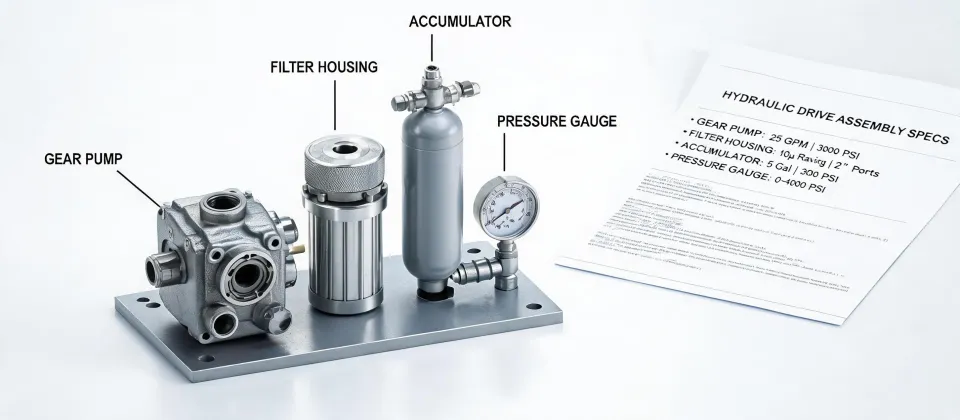
Our packing line lost pressure one Tuesday. Maintenance found the HYDAC gear pump on the hydraulic power unit had failed. We needed a replacement fast.
I got two quotes. The first came from a HYDAC industrial parts reseller I'd worked with before. $1,180. Three-week lead time. They asked for the pump series, the shaft type, and the port orientation before quoting. The second quote came from a large online supplier that listed the same HYDAC gear pump under a generic photo. $910. Two-day delivery.
I had two hours to decide because the production manager was watching. Normally I'd have asked for drawings, but there was no time. I went with the cheaper one based on the part number alone.
It bolted up. But the ports were on the wrong side. The pump body was the same displacement, but the inlet and outlet ports were configured for a different manifold. Hoses couldn't connect. We needed a $700 custom adapter and a 6-day wait.
When I compared Quote A and Quote B side by side after the fact, I finally understood why the good reseller asked those questions. The cheaper quote didn't include the port configuration because the listing didn't know it was optional. (note to self: never order a replacement pump without a port orientation drawing.) Looking back, I should have called the manufacturer's application line. At the time, I thought it would take too long. It would have prevented the mistake.
The $270 I saved on the pump turned into $700 for machining plus $530 in overtime installation—plus the production delay. That's more than the first quote, even before you count the lost trust. That's when I started calculating total cost of ownership before comparing any vendor quotes.
Why a HYDAC industrial parts reseller still makes sense
I don't want to scare you away from resellers. In some cases, a good reseller knows more about the local installed base than a general manufacturer office. They can help with cross-references, stock checks, and old part numbers. Quote A in my story came from a reseller; they were not the cheapest, but they asked questions that prevented my mistake. The good ones are worth their margin.
The issue is that "reseller" covers a lot of businesses. Some carry genuine HYDAC industrial parts and have engineers on staff. Others are online storefronts that print a part number on an invoice. Both can be useful. But the cheaper the quote, the more questions you should ask.
The gear coupling detail everyone forgets
I thought I learned my lesson. Four months later, I did it again on a smaller scale.
We needed a gear coupling for a screw conveyor. I measured the shaft with a caliper: 38 mm. I ordered a gear coupling with a 38 mm bore. It arrived, and the hub bore was correct. But the keyway was 6 mm, and the shaft used an 8 mm key.
A gear coupling is not a universal joint. According to AGMA's coupling standards, a gear coupling's rating assumes proper lubrication and reasonable alignment. But in the real world, the first thing that gets checked is bore size. Keyway, shaft retention, coupling type, lubricant—they get ignored until someone is staring at a box of parts that won't go together.
This mistake cost about $320 in freight, machining, and a day of downtime. It also made me realize that I keep hunting for a single compatibility number instead of asking: "What is the total fit condition?" Maybe that's why the phrase "compatible with HYDAC" makes me nervous.
Capacitor start AC motors: same specs, different machine
The TCO lesson carried over to motors. We once replaced a burned-out 1.5 hp single-phase motor on a small hydraulic power unit. The replacement was a capacitor start AC motor with the same frame size, same 1,725 rpm, and same shaft dimensions. It was $263 cheaper than the one we usually used.
It failed on day three. Period. The fine print said "duty: intermittent S2 60 min." Our pump runs in eight-hour shifts. I didn't know S2 meant the motor could only run for 60 minutes before needing to cool down. I bought a motor based on horsepower and frame, not duty.
According to NEMA MG 1, a motor frame size is a dimension standard—it tells you how the motor mounts, not what it can do. And according to IEC 60034-1, duty cycles are part of a motor's rating. If you skip the duty rating, you're not comparing motors—you're comparing prices.
So when someone asks me about capacitor start AC motors now, I say: check the duty cycle, the starting torque, and the thermal protection. The start capacitor is there to get the motor moving and then drops out. If the load is too high after start, the motor can overheat and fail. The invoice price was $263 cheaper, but the real cost was about $740 in replacement labor and rush delivery—plus days of lost production.
What's a stepper motor? (and why I ask before I buy)
After the motor failure, one of the junior engineers asked me: "What's a stepper motor?" He was looking at a budget motion control retrofit for a feed table.
A stepper motor moves in fixed steps—usually 200 full steps per revolution, or 1.8° per step. A controller sends pulses, and the motor holds its position after each pulse. It's open-loop, meaning it doesn't measure whether it actually reached the commanded position. That makes it simple and relatively cheap. If you know the load and can keep it under the torque curve, a stepper can work very well.
But when a stepper loses a step, it doesn't stop and tell you. It just misses the mark. In a machine, that can create a jam, a scrap part, or a collision. I've seen a $50 motor choice cause a $3,000 repair. (Yes, I've seen it. I was there.)
So when the question "what's a stepper motor" comes up, my answer is: it's a precise, repeatable, open-loop positioning motor—and you need to be honest about whether the machine can tolerate a lost step. If not, a closed-loop servo or a linear actuator is closer to "cheap" once you count the risk.
A five-line checklist that catches most problems
I now keep a checklist on the wall. It isn't a detailed engineering document; it's just enough to force us to think before ordering. I've caught 47 potential errors with it in the past 18 months.
- Does the part number match a drawing, not just a product name?
- What are the mounting dimensions—shaft, flange, port orientation, keyway?
- What's the duty rating or operating condition of the component?
- What's the lead time, and what happens if it's wrong?
- What does the total cost include beyond the purchase price?
This is rough, but it catches the same failure patterns every time: buying by name, buying by price, and buying in a hurry.
When this approach doesn't apply
To be honest, this checklist doesn't help if you're designing a new machine from scratch. A replacement-part setup has existing constraints—mounting dimensions, pipe sizes, coupling types, and duty cycles. A new design can choose whatever makes sense. Different problem, different process.
It also won't help if you're dealing with a complete custom engineered solution. There's no substitute for drawings, calculations, and a proper application review. My approach is for people like me: trying to keep existing systems running without making a bad situation worse.
Bottom line: a HYDAC industrial parts reseller is not the risk. The risk is when you stop asking questions because the part number looks right. Ask the boring questions about port orientation, keyways, duty cycles, and motion control. The answers are cheap. The mistakes are expensive.