If your machine is down and you need HYDAC industrial spare parts fast, the fastest path isn't more frantic searching—it's pulling the full nameplate data and system schematic together first. Skip that step, and you'll burn hours chasing parts that almost fit during the time you can least afford it. In my years coordinating rush orders for hydraulic and motion components, that one decision determines whether you're back up today or nursing a plan B through the weekend.
I'm an emergency sourcing specialist at a small engineering services company. I've handled 200+ rush orders in seven years, including same-day turnarounds for food plants, packaging lines, and a few steel mills. Last quarter alone we processed 47 hot jobs with 95% on-time delivery. So when I say "get the data first," it's not a slogan—it's the difference between ordering the right filter once and paying twice.
What I Learned From 200+ Emergency Orders
The most frustrating part of parts procurement? You call a distributor with a "quick question" and end up on hold while production is stopped. You'd think a part number would be enough, but I've been burned by revision changes twice. A pump with the same model number but a different shaft diameter is not the same pump.
Before you call anyone, grab:
- The complete nameplate data (model, serial, voltage, current, pressure rating).
- System fluid type and operating pressure.
- Any controller or drive details—especially for motors.
- Your cleanliness target for hydraulic filters (you can find it in the maintenance manual).
That list seems basic, but you'd be amazed how many maintenance teams skip it and try to identify a part from memory.
Catalog Numbers Are Not Enough
It's tempting to think that if you find the part number in the HYDAC filter catalog, everything else is settled. But that's a simplification. The same catalog number can have different seal compounds, bypass valves, or collapse-pressure ratings. Ordering by number without checking the operating conditions is how you end up with a filter that fits but fails in half an hour.
That's why, in a rush, we still verify the filter element's Beta ratio (per ISO 16889) against the system's ISO 4406 cleanliness code. If your oil has a target of 16/14/11, a 10 µm Beta 200 element is a completely different part than a 25 µm filter, even if they share a housing. The catalog is a map, not the territory.
For example, I watched a maintenance team match a filter element to a generic equivalent by thread size alone. It threaded in fine, but the bypass pressure was wrong. On a cold start, the pressure spike blew the housing gasket and cost them a full shift. The replacement filter was cheaper by maybe $30. The cleanup cost thousands.
The Spur Gear Question, Answered
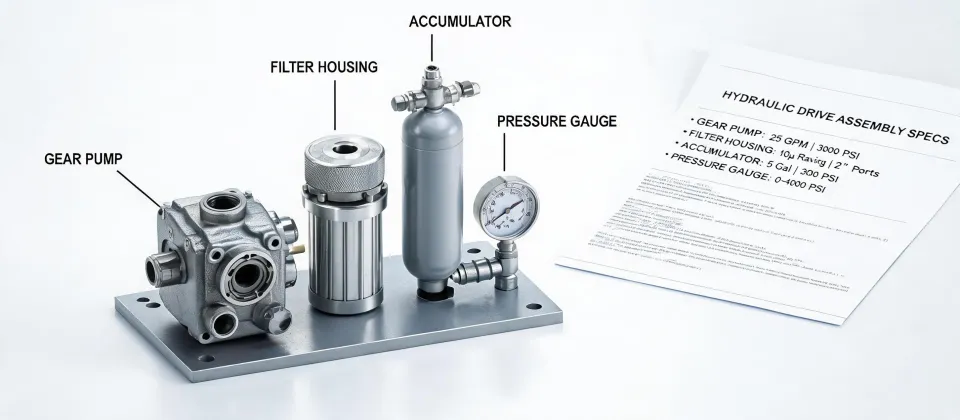
Someone asked me recently, "which gear is most likely to use a spur gear?" It's not just trivia—it matters when you're buying a replacement pump in a hurry. In standard external gear pumps, the gears are almost always spur gears. Spur gears are simple, cheap, and perfectly adequate for constant-speed, medium-pressure hydraulic service. Helical gears are quieter and handle higher loads, but they're usually in more refined pumps and cost more to produce. So if you see "gear pump" on a selection sheet, "spur gear" is the safe answer.
In my experience, many HYDAC gear pumps use exactly that architecture. When ordering a replacement, you still need to confirm displacement, direction of rotation, and the coupling type—but knowing it's a spur gear pump tells you what you're working with.
Mini Servo Motors vs. Stepper Motors
Another trap is mixing up motor families. I've seen maintenance engineers point to a mini servo motor and ask for a "small AC motor" as a replacement. Those aren't interchangeable. A mini servo motor has closed-loop feedback, high peak torque, and precise velocity control. Stepper motors are simpler, open-loop, and can lose steps under acceleration or load.
If the original machine used a mini servo motor for smooth positioning, swapping in a stepper is a gamble. I once watched a packaging line try to save money by replacing a servo with a stepper motor. It ran for two days, then skipped steps in the middle of a high-speed registration move. The rework and downtime cost them more than the servo would have.
So when someone tells you "they're both just small motors," push back. A motor is only a good replacement if its drive, feedback, and torque curve match the application.
When Paying More Is the Smart Spending
I have mixed feelings about rush fees. On one hand, paying 50% extra for overnight freight feels like gouging. On the other, I've watched production lines lose far more in an hour. Maybe the premium is really a small insurance policy.
But one thing I don't compromise on is component quality. In my opinion, the filter element or motor you install is a direct extension of your company's reputation. A cheap seal that leaks after a week makes your whole maintenance program look careless. A $50 difference per component is nothing compared to the cost of a second shutdown. I've seen clients move from budget filters to a premium HYDAC element and report noticeably fewer unscheduled stops—that's not magic, it's simply the right material and filtration rating for the job.
Calculated the worst case: buy the cheap knockoff, lose another day when it fails, and have the production manager question every future recommendation. Best case: save 15% on one component. The expected value always points to the proven part, especially when downtime penalties are on the table.
When to Ignore This Advice
Of course, not every part request should be an emergency. If your machine has a backup pump or you're already in a planned maintenance window, standard lead times are fine. If your equipment is under warranty, don't even think about aftermarket parts—use the HYDAC original spare parts channel and keep the paper trail. And if the machine has been heavily modified, rely on the OEM's guidance first, not just the catalog.
Take this with a grain of salt if your application is truly custom. I'm not 100% sure every shortcut I've described applies to every hydraulic or motion control system. But I am sure about this: the part is not the goal. The running machine is the goal.
The part is not the goal. The running machine is the goal.
One last thought: even the right part can fail in the first hour if the installation is sloppy. A spur gear pump survives only if the shaft alignment is good and the coupling is torqued correctly. So when you're in a hurry, slow down on those final steps. Rushing the start-up is how a "successful" repair turns into another overnight call.