It was 3:00 PM on a Friday when our maintenance lead called. Another servo motor had failed on the packaging line. The machine had been down for two hours, and production was already behind schedule. He asked me to order a replacement—fast. I’d been through this before. But something was different this time: we had already replaced that same motor twice in nine months.
That’s when I started asking questions. Not about the motor itself, but about why we kept needing replacements. If your plant relies on hydraulic filters, gear pumps, or electric motors, you’ve probably been in the same position. Let me share what I’ve learned as the person responsible for ordering these parts—and why the solution isn’t always “find a cheaper supplier.”
The Problem You Probably Think You Have: Bad Components or Slow Suppliers
When equipment fails repeatedly, the easiest explanation is that the components are cheap or the supplier is slow. And sometimes that’s true. But in my experience—roughly $1.2 million in MRO purchasing across nine facilities over the last five years—that’s rarely the root cause.
Most of the time, the real issue is that the wrong part is being installed for an application it wasn’t designed for. It’s not that the part is bad; it’s that it doesn’t match the operating conditions. I’ve seen this pattern many times. And when I say “many,” I do not mean just a few—I mean consistently across 200+ orders.
The Real Problem: It’s Usually Not the Part Itself
Take servo motors. The conventional wisdom is that repairing a servo motor is cheaper than buying a new one. That’s often true—the first time. But after three repairs on the same motor, you’ve probably paid more than a new unit, plus you’ve lost production hours while each repair was completed. I had to learn this the hard way.
It took me about two years and 100+ repair orders to understand that every repair has a hidden cost: the time the motor spends at the repair shop, the risk of quality variance when it comes back, and the internal labor to reinstall and test it. Sometimes repairing is still the right move. But you need data to make that call, not just a “rule of thumb.”
Another example: squirrel cage induction motors connected to variable frequency drives (VFDs). A lot of maintenance teams don’t consider how VFD control motor speed—they change both frequency and voltage—can stress a motor that wasn’t designed for inverter duty. Unless you’re using a motor rated for VFD use, the windings can degrade faster due to voltage spikes, and the bearings can fail from shaft currents.
Now, I’m a buyer, not an engineer. But after years of seeing the same failures repeat, I’ve learned to ask about these things. And here’s the key: the information to make the right decision is available—if you know where to look.
For example, when our team needs to identify the exact HYDAC filter element or cartridge valve, we don’t call the sales rep and guess. We download the latest HYDAC catalog PDF from their website, look up the part number, and check the specifications against our system’s requirements. That simple step has eliminated a huge number of wrong orders.
What Poor Selection Actually Costs You
The price of a mismatched part is not just the purchase price. It’s the downtime, the rush freight, the overtime labor, and the knock-on effect on customer delivery promises. Let’s break down what I’ve seen:
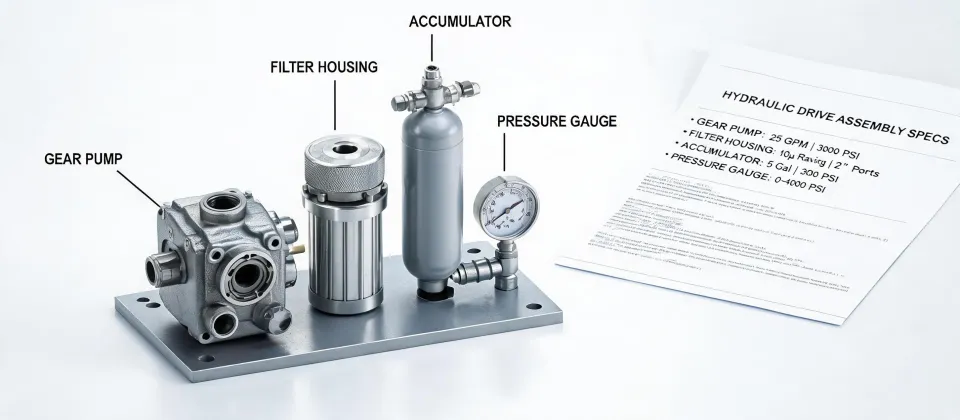
- Wrong filter elements: Using a filter with the correct thread but an incorrect micron rating can damage a hydraulic pump. The pump doesn’t fail immediately, but the wear accumulates. Replacing a gear pump costs thousands; replacing a filter costs tens of dollars.
- Servo motor repair vs. replacement: That motor on the packaging line? We repaired it in January for $1,800. It failed again in April, and the rush repair cost $2,400 with expedited shipping. By July, we finally replaced it with a new motor for $3,900. Total cost: $8,100 plus five days of production downtime. A single new motor would have been cheaper from the start.
- VFD and motor mismatch: Squirrel cage induction motors are often called “the workhorse of industry” because they’re tough and simple. But when you pair an old motor with a new VFD without checking for inverter-rated insulation, you’re gambling with its life. The motor might last six months instead of six years.
The worst part is that these costs are rarely itemized. They show up as “unplanned maintenance” in the budget, and we just write them off as if they were unpredictable. They’re not. Most of them are preventable.
“I’ve learned to ask ‘what’s NOT included’ before ‘what’s the price.’”
That applies to parts as much as it does to services. A “cheap” motor might not be rated for inverter duty. A “compatible” filter might not have the right bypass valve. And a “repaired” servo motor might be using salvaged components that won’t hold up under your load cycle.
Part of me still wants to save a few dollars on every purchase. Another part knows that the last time I bought solely on price, I spent the next two weeks explaining why the “bargain” filter destroyed a pump. I’ve come to believe that the cheapest part is often the one that works—not the one with the lowest quote.
How to Break the Cycle (Without Becoming a Hydraulic Engineer)
You don’t need to become a technical expert to avoid these problems. You need systems and processes to ensure the right part gets installed. Here’s what works in our plants:
- Use official catalogs, not passed-down word of mouth. For any HYDAC product, download the latest HYDAC catalog PDF. It includes dimensions, materials, pressure ratings, and cross-reference info. When the maintenance team requests a part, we’ve started including the catalog page number in our purchase order. This sounds bureaucratic, but it catches mistakes before they turn into downtime.
- Track lifetime costs of repairs vs. replacements. Create a simple spreadsheet that tracks the purchase price, repair costs, and downtime hours for each critical component. You don’t need ERP-level sophistication; a shared Google Sheet works. After a few quarters, the pattern will be obvious.
- Ask the supplier to verify compatibility. When you call a distributor, don’t just read a part number. Give them your application details—motor type, load profile, ambient temperature, type of control (e.g., VFD). A reputable supplier will ask you for these. If they don’t, that’s a red flag.
- Understand the basics of how VFD control motor speed. At minimum, you should know that a VFD adjusts both frequency and voltage to change a motor’s speed and torque. That knowledge might help you understand why an induction motor needs inverter-duty insulation if it will be run from a VFD.
- Buy from manufacturers or distributors who provide transparent data. For example, HYDAC’s industrial parts have detailed specifications online, including CAD files and technical bulletins. That transparency allows buyers to verify fit and function without needing a master’s degree.
This might sound like a lot of work. But consider the alternative: the next time a machine goes down, you’ll be at your desk at 3 PM on a Friday, trying to explain why the second emergency repair this year is not going to be the last.
I’m not saying HYDAC is the only good supplier out there. But I’ve learned to prioritize vendors who make it easy for me to see what I’m actually getting. Whether it’s a filter cartridge, a gear pump, or a servo motor, the right part—selected with the right information—is worth more than a low price. And that’s a lesson I wish I’d learned a lot sooner.