It Started on a Tuesday
It was a Tuesday in October 2022. I was on my second coffee when the plant manager called. The hydraulic press on Line 3 had stopped mid-cycle. Not the slow, gradual kind of failure you can plan around. Just a hard stop, with the ram halfway down and a pool of oil spreading underneath the manifold.
I've handled spare parts and maintenance orders for industrial equipment for about eight years now. In that time, I've personally made—and documented—four significant mistakes. Combined, they wasted roughly $9,000 of budget and cost our team weeks of headaches. This one, the third, was the worst: $3,800 in parts we couldn't use and a week of downtime on a machine the production schedule really needed.
The worst part? It was entirely preventable.
The HYDAC Cartridge Valve I Ordered From Memory
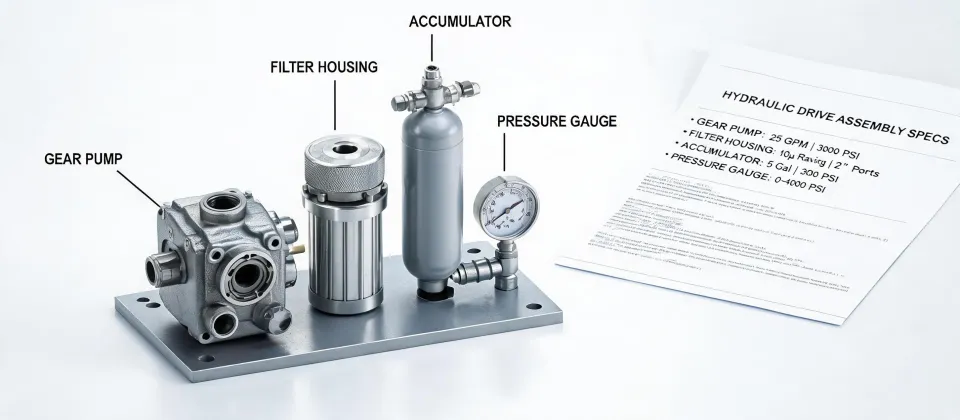
The press's hydraulic power unit was losing pressure. I diagnosed the problem as a failing cartridge valve in the main manifold. Nothing exotic. We'd replaced similar valves before, and the unit itself was a pretty standard setup—a gear pump, a few directional valves, and a bank of cartridge valves doing the logic work.
I'd always trusted HYDAC components in this machine. Their cartridges are consistent, and the seal options cover most fluids we use. But here's the thing I'm not proud of: the day I placed that order, I didn't open the HYDAC cartridge valve catalog. I didn't check the HYDAC catalog PDF on my laptop. I typed a part number from memory—a number I'd used two years earlier on a completely different manifold.
When the valve arrived, it looked right. That's what made it worse. Same size, same thread, same general shape. But the sealing arrangement was different, and the pilot port didn't line up with our cover. Try forcing a cartridge valve that doesn't match the cavity—you'll lose a seal and a lot of oil before you accept defeat.
I still kick myself for that order. If I'd spent five minutes verifying the part number against the HYDAC catalog PDF, we'd have saved two days of downtime right there. Instead, we paid rush shipping on the correct part, ate the cost of the wrong one, and explained to management why a "simple valve replacement" took a week.
A Three-Phase Induction Motor, a Brushless Option, and a Colleague Who Meant Well
While we waited for the correct valve, I turned my attention to the press's drive motor. It was a three-phase induction motor, original to the machine, and it had been rewound at least twice. The bearing noise was getting worse, and the insulation smelled hot after long runs. It was time to plan a replacement.
Then my colleague started the debate. Why not go with a brushless motor? Better efficiency, better speed control, longer life. He wasn't wrong. Brushless motors are great in the right application.
But this press wasn't the right application. It needed a motor that matched the existing frame size, mounting holes, and duty cycle. It needed to run continuously at a fairly constant load. A three-phase induction motor does that reliably and cheaply. A brushless setup would've meant a new mounting arrangement, a new controller, and a longer commissioning process—all to reduce energy use on a machine that runs for maybe 40% of the working day. In my opinion, that's a classic upgrade that sounds good in the break room but doesn't pay for itself on the floor.
We went with a new three-phase induction motor. Even after choosing it, I kept second-guessing. What if my colleague was right? What if the plant's energy goals meant we'd regret not going brushless? The two weeks until delivery were stressful. In hindsight, the doubt was a waste of energy. The induction motor runs exactly as it should.
How VFD Control Motor Speed—and Why I Finally Learned It
Here's the part that humbled me. I'd worked around motors and drives for years, but if someone had asked me how VFD control motor speed works, I would've given a vague answer. Something about "changing the frequency." I knew the word. I didn't understand the mechanism.
We added a variable frequency drive to the new motor because the press needs different ram speeds for different cycles. The VFD tech walked me through the basics after commissioning, and he was patient enough to repeat himself.
The explanation, stripped down: an induction motor's speed is tied to the frequency of the AC power feeding it. The drive rectifies incoming AC to DC, then synthesizes a new AC waveform at the frequency we want. Higher frequency = faster motor. Lower frequency = slower motor. At the same time, the drive adjusts voltage so the ratio stays constant—that's what prevents the motor from overheating when it runs at low speed.
The synchronous speed calculation is straightforward: speed equals 120 times frequency divided by the number of poles. It's not complicated. What took me a while to internalize is how the drive's settings—acceleration time, torque limits, minimum frequency—matter more than the base theory in day-to-day operation. The theory is easy to read. Tuning is a skill.
I don't think I was the only maintenance person in that position. Most technicians I meet know what a VFD is. Way fewer can explain what's actually happening inside. I'm not blaming anyone. I just think the industry overuses "black box" logic and underuses curiosity.
The Checklist That Finally Stopped the Bleeding
After the whole mess—the wrong valve, the motor debate, the VFD commissioning—I sat down and wrote a pre-order checklist. Not for anyone else. For me. Then I shared it with the team, and now it's part of how we do things.
It's nothing glamorous:
- Open the HYDAC catalog PDF and verify the exact part number against the markings on the old component.
- Check seal material compatibility with the system's hydraulic fluid.
- Confirm the cavity dimensions and pilot configuration—in writing, not from memory.
- Match motor frame size, duty rating, and enclosure class before considering efficiency.
- Write the VFD's min and max frequency settings on the nameplate tag for the next person.
In the 18 months since, that checklist has caught 47 potential errors. I keep a log. 47 orders that would have been wrong in some way—wrong revision, wrong seal kit, wrong voltage. Not all would have caused downtime. Some would've just been annoying returns. But a few, honestly, would've been disasters.
The way I see it now, the checklist is the cheapest insurance we have. Five minutes of verification beats five days of correction. That's not a slogan. That's the arithmetic of this industry.
The Bottom Line
If you take one thing from this, let it be this: the expensive mistakes in industrial maintenance are rarely about not knowing a system. They're about skipping verification because you're confident, or rushed, or tired. Confidence is not a substitute for checking the catalog.
I've seen this pattern many times. But when I say "many," I do not mean a few—I mean consistently, across hundreds of orders and dozens of plants. People order from memory. People skip the notes. People assume the part number they used last year is still the right one.
Prevention isn't glamorous. It's opening a PDF, reading the part number out loud, and checking the seal size twice. It's writing down the VFD settings instead of trusting that "someone else" remembers. It's the boring stuff that nobody thanks you for—until the day it saves you the kind of week we had in October 2022.
We paid $3,800 and a week of production time for that lesson. If my story helps one person avoid it, that's fine. Just open the catalog. It's right there.