When I took over procurement for our mid-size manufacturing facility, I thought the biggest win would be slashing component prices. Filters, motors, bearings — get the lowest quote, order in bulk, done. That was my plan for six months. Then reality hit.
Our maintenance team started flagging issues: a gear pump that kept cavitating, a servo drive that wouldn't hold position, linear bearings that seized within weeks. The common thread? Every component was cheaper individually, but none of them played well together. That's when I learned the hard way: lowest price per part rarely equals lowest total cost of ownership.
The Surface Problem: Price-Driven Procurement
Most engineers and buyers I talk to start the same way. They search for "hydac buy industrial supplies" to get a catalog, then compare prices across distributors. They pick the cheapest filter element, the most affordable servo motor, the lowest-cost linear bearing guide components. On paper, the savings look real — maybe 15-20% off retail.
But here's the catch: compatibility isn't just about dimensions. It's about system behavior. A brushless DC motor control that's slightly off-spec can cause resonance in a coupled gearbox. A generic linear guide with wrong preload tolerances introduces backlash that degrades positioning accuracy over time. And if you think a bevel gear set is just a bevel gear set? Well, I've got a story for that.
The Deeper Cause: What Most Buyers Miss
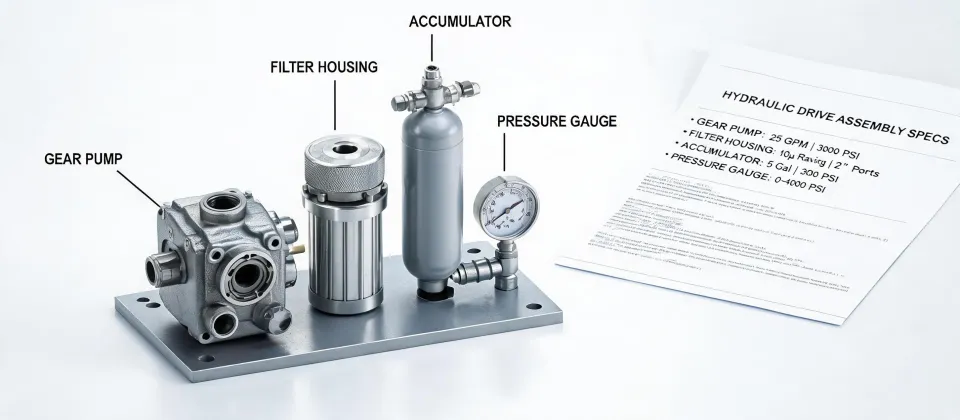
The real issue isn't component quality — it's integration complexity. Industrial systems are designed with specific interaction profiles. A hydraulic filter from one brand might have the same thread size, but its bypass valve setting and filtration micron rating could shift the fluid dynamics just enough to shorten pump life.
Let me give you a concrete example. Last year we sourced a batch of linear bearing guide components from a third-party supplier — looked identical to the OEM parts, cost 30% less. Within three months, two machines had to be taken offline due to excessive wear on the carriage rails. The problem? The bearing material coefficient of friction was slightly higher, causing thermal expansion that misaligned the entire slide assembly. Our maintenance team spent 40 hours diagnosing and replacing. That "savings" turned into a net loss of $4,200 in downtime and labor.
Another underappreciated factor: documentation. The OEM's "hydac manual" includes not just part numbers, but torque specs, fluid cleanliness requirements, and operating limits. When you substitute without cross-referencing those parameters, you're flying blind. (Note to self: always request test reports before approving alternative suppliers.)
And then there's the motor controller trap. I've seen engineers design a brushless DC motor control loop using generic parameters, only to discover later that the encoder feedback frequency was mismatched — causing speed ripple that took weeks to debug. Why? Because the datasheet for the cheap driver omitted the minimum PWM dead-time requirement.
The Real Cost: More Than Just Rework
The direct costs are obvious: replacement parts, technician overtime, production delays. But the hidden costs are worse.
"A 5-minute check saved us $8,000 in potential rework on one project. I'm not exaggerating."
Lost learning time. Every time a component fails unexpectedly, the engineering team has to stop what they're doing to troubleshoot. That's expensive — their hourly burden rate might be $80-$120, and they could have been improving a process rather than firefighting.
Inventory complexity. When you buy a mix of OEM and non-OEM parts, your spare parts inventory grows — more SKUs, more bins, more confusion. Our warehouse once stocked four different filter elements that all fit the same housing, but with different micron ratings. Guess which one the maintenance crew grabbed during a quick change? The wrong one. That led to a pump failure and a $2,500 emergency repair.
System reliability erosion. The worst cost is gradual degradation. A machine that used to run 98% uptime slowly drops to 94%, then 90%. Nobody notices until quarterly reports show declining output. But the root cause traces back to a $200 cheaper motor that draws 5% more current, overheating the drive.
I tracked our cumulative spending across 18 months — about $180,000 in component purchases. When I calculated the total cost of ownership including related failures and maintenance, the "savings" from sub-optimal parts added up to a net increase of 12%. (mental note: I should build a TCO calculator for next year's budget review.)
What I Do Now: Prevention Over Cure
After that wake-up call, I changed our procurement process. It's not about avoiding third-party parts — some are excellent. But we now have a simple preventive checklist before any substitution:
- Compare all critical parameters from the OEM manual (yes, actually read the hydac manual for filters, motor specs for drives, etc.)
- Request compatibility test results from the supplier — especially for brushless dc motor control setups and linear bearing guide assemblies
- Check application context: a bevel gear that works in a low-speed conveyor might fail in a high-acceleration robot joint (that's what uses a bevel gear properly — or not).
We also standardized on a few approved suppliers for core components. For hydraulic filtration, we stick with HYDAC because we've verified their catalogs and support. Not because they're the cheapest — but because the total cost, including manual accuracy and aftermarket support, is predictable.
Does this mean we never buy outside the OEM? No. But we now treat every substitution as a design review, not a price comparison. Five minutes of cross-referencing beats five days of rework.
I can only speak to our context — a mid-size plant with mixed automation. If you're running a simple conveyor line with one motor type, your mileage may vary. But if you're integrating multiple motion axes, hydraulic circuits, and gearboxes, the calculus changes. Because the component that looks like a bargain today can become a $10,000 headache six months from now.
That's the real cost. And the only cure is prevention.