I've been a procurement manager at a 40-person automation systems integrator for six years. I track every equipment order in a cost system that now holds about $180,000 in cumulative purchases. I'm saying this upfront because my view on motion control components comes from invoices, returns, and one very preventable line stoppage—not from marketing materials.
That line stoppage started with a $35 driver board. A cheap, look-alike A4988 stepper motor driver. It cost us $1,800 in downtime.
The Surface Problem: A "Good Deal" That Stopped a Line
When a machine loses a stepper driver or a servo motor, the surface problem is simple: production stops, and you need a replacement fast. If you're the person looking for parts, your first instinct is often to find the cheapest component that resembles the old one. I used to think that was a reasonable procurement strategy.
It isn't.
In our case, the old driver was an industrial stepper drive rated for our 3 A load. Someone (I'll spare you the details) found a board with the same general shape and the word "stepper" in the title. It was an A4988 stepper motor driver, the kind of breakout board used in 3D printers and tiny CNC machines. The A4988's datasheet lists a maximum output current of ±2 A per phase and a 35 V limit. Our load was 3 A at 48 V. The board was undersized before it ever arrived.
It died on the first production shift. The replacement industrial driver cost $310. The downtime—four hours at our loaded shop rate—cost about $1,800. That's the real price of a $35 bargain.
So What's a Stepper Motor, and Why Does the Difference Matter?
Whenever someone asks me "what's a stepper motor?", I explain it like this: it's a motor that moves in fixed steps, one step for each electrical pulse from the driver. No feedback loop needed. That's why steppers are simple, inexpensive, and great for low-speed positioning where you don't need to hold high torque under changing loads.
A servo motor is different. It has an encoder or resolver that sends position feedback to the drive, and the drive constantly corrects the motor's position. Servo motors cost more, but they handle speed changes, torque spikes, and closed-loop accuracy better than steppers.
Neither is "better" across the board. But knowing the difference can save you from buying the wrong thing. If you need to index a light table at low speed, a stepper is often the right call. If you're running a winder that changes load constantly, servo motors will beat a stepper every time—no matter how attractive the stepper's price is.
The Deeper Cause: We Were Buying Parts, Not Performance
The real problem wasn't the failed driver board. It was my process. I was price-shopping components by picture and vague descriptions. I wasn't asking:
- What are the actual voltage, current, and duty cycle requirements?
- Does this application need stepper or servo behavior?
- Who takes responsibility if the component is wrong?
When I started asking those questions, my cost tracking changed. In January 2025, I compared two quotes for a servo motor replacement. The first vendor quoted $2,100 per motor, including freight and a commissioning call. The second quoted $1,650 per motor. The second one looked better until I added $340 freight, $220 in "documentation fees," and no technical support. Total: $2,210 each—higher than the "expensive" option.
The upside of the cheaper quote was about $4,500 in annual savings. The risk was a startup headache, possibly a wrong encoder mating, and a warranty fight. I kept asking myself: is $4,500 worth six days of line stoppage? A TCO spreadsheet answered that question in about ten minutes.
Even after I approved the $2,100 quote, I doubted myself. What if I was paying for a logo? The two-week lead time felt long. I only relaxed when the motors arrived with matching connectors, correct shaft keys, and documentation that answered our wiring question in one email. That was the moment I understood: I wasn't buying a part. I was buying certainty.
The Catalog Habit
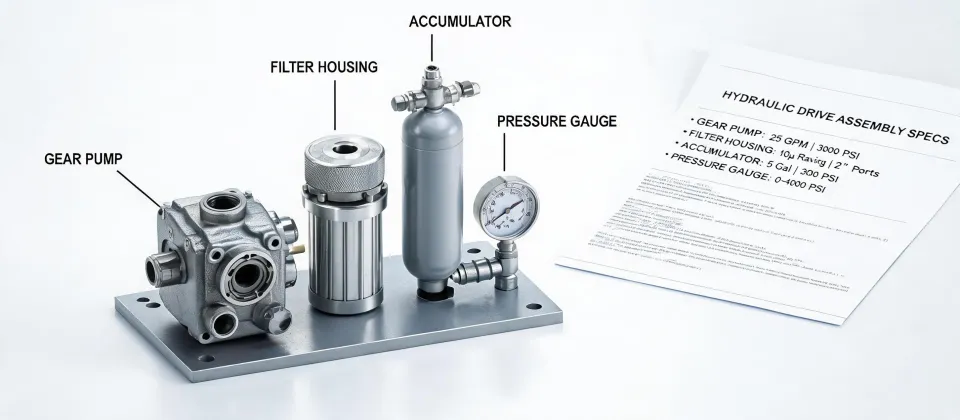
Fragmented sourcing makes these mistakes worse. I see it with hydraulic parts too. A maintenance engineer under pressure will often grab whatever filter "looks close" to the failed one. When we standardized on the HYDAC filter catalog for our hydraulic fluid conditioning, we stopped guessing. The catalog gives us a part number, filter fineness rating, application range, and cross-reference data. That's not a luxury. It's insurance against the $1,800 mistake.
The same logic applies to motion control. If you buy through a HYDAC industrial equipment reseller—or any distributor that actually validates part numbers—you gain a chain of responsibility. A good reseller asks about voltage, ambient temperature, and duty cycle before submitting the order. That saves both of us money.
What Downtime Actually Costs
Let's put the cost of ignoring the problem in one line: the $35 A4988 driver failed in four hours. The replacement industrial stepper driver cost $310. The difference was 8.8 times. But the downtime was $1,800. And the most expensive part of the entire incident was not the part. It was the decision to skip a five-minute spec check.
I am not saying every cheap component is garbage. The A4988 is honestly a nice little driver for the right job—a prototype, a hobby machine, a low-power bench test. But if you put a 2 A max driver on a 3 A production load, you have not "saved" money; you have pre-purchased a failure.
The Fix: Prevention Over Cure
My answer is deliberately boring: use a checklist, and use it every time. The checklist I created after this incident has three questions:
- Is this component rated for the actual voltage, current, and duty cycle?
- Is the motor type actually right for the application—stepper or servo?
- Does the supplier provide a clear return path and technical support?
Those three questions would have caught the A4988 problem in about five minutes. Five minutes of verification beats five days of correction. That isn't a slogan; it's how I then justified $8,000 in avoided rework to my CFO, based on our own incident notes.
The solution is not to overpay. It's to understand the total cost of what you're buying. Use catalogs instead of memory. The HYDAC filter catalog is a good model: if you're replacing a hydraulic filter, you don't order "the one that was in there" by feel. You look up the part number and confirm the rating. Motion control deserves the same rigor.
And when in doubt, talk to a HYDAC industrial equipment reseller—or a similarly qualified motion control distributor—before you issue the PO. They'll ask you questions you don't expect. That's a feature, not a delay.
Last week, a maintenance tech asked me why our replacement-part failures dropped by 40% after we implemented the checklist. I told him the truth: because we stopped buying components and started buying certainty. It's not as impressive as a data center full of servos, but it's a lot cheaper.