-
Step 1: Pull the Full Motor Nameplate Data
-
Step 2: Measure the Actual Running Current
-
Step 3: Confirm Line Voltage and Phase — Before You Order
-
Step 4: Classify the Load — Variable Torque or Constant Torque
-
Step 5: Size by Current, Not Horsepower
-
Step 6: Check Cable Length and Power Quality (The One Most People Skip)
-
Step 7: Don't Skip the Motor Health Check — and Know the Servo Motor Repair Difference
-
Step 8: Plan the Spare Parts Strategy Before You Need It
-
The Mistakes I See Most
-
Bottom Line
Two weeks ago, a plant engineer called me at 4:47 PM. His 5HP 3 phase induction motor — the one driving a hydraulic power unit — had tripped the breaker again. If he didn't have it running by 7 AM, the entire morning shift was going to be standing around doing nothing. His first question was the same one I get nearly every week: what size VFD do I need for a 5HP motor?
When I first started sizing VFDs, I assumed you just matched the nameplate horsepower. A 5HP motor gets a 5HP drive, right? That assumption lasted exactly until I watched a drive I'd selected fault out three times in one week under a constant-torque load. Since then, I've run through the same sequence on 120+ VFD replacement jobs, and it hasn't failed me.
So here's the checklist, exactly as I use it. It applies whether you're designing a new system or scrambling to replace a failed drive.
Step 1: Pull the Full Motor Nameplate Data
Don't just look at "5 HP." Write every line down:
- Full Load Amps (FLA) — this is the number that matters most
- Voltage — 230V, 460V, or 575V
- Phase — single or three
- Frequency — 50 or 60 Hz
- Service factor — usually 1.0 or 1.15
- Frame size — needed for mounting
Per NEMA MG-1, a standard 5HP, 460V, 3-phase motor has an FLA of about 7.6 amps at 60 Hz. The same 5HP motor at 230V pulls 15.2 amps. If you size a VFD using horsepower alone, you're betting the whole production line on a guess.
Step 2: Measure the Actual Running Current
The nameplate tells you what the motor is allowed to draw, not what it's actually drawing in your application. Clamp a meter around one motor lead and take a reading under real load.
If the measured current is already at or above FLA, a new VFD won't fix it. Something is forcing the motor to work harder — a restricted hydraulic filter, a misaligned coupling, a pump in the early stages of failure. The VFD will trip on overload either way.
I learned this the hard way in 2023. A client was certain they needed a bigger VFD because their motor kept tripping. I traced it to a return filter two stages past its change-out interval. An $80 filter element solved it. The bigger VFD they'd budgeted for? $1,400, and it wouldn't have helped one bit.
Step 3: Confirm Line Voltage and Phase — Before You Order
This sounds too basic to say out loud, and yet I'd estimate over 20% of the VFD returns I see trace back to voltage-class errors.
Know three things: your line voltage, how many phases, and whether the voltage is stable. Facilities with large cycling loads — injection molders, welders, elevators — often see voltage sag that causes drives to fault. If your supply dips below the drive's tolerance, no amount of oversizing fixes it.
Step 4: Classify the Load — Variable Torque or Constant Torque
This is the decision that separates an okay selection from a genuinely reliable one.
- Variable torque — fans, centrifugal pumps. The load increases with the square of the speed. Most standard VFDs handle these fine at their nameplate rating.
- Constant torque — conveyors, mixers, positive-displacement pumps, and hydraulic gear pumps. The load stays high across the speed range. These need a drive rated for constant-torque duty, and often one frame size up.
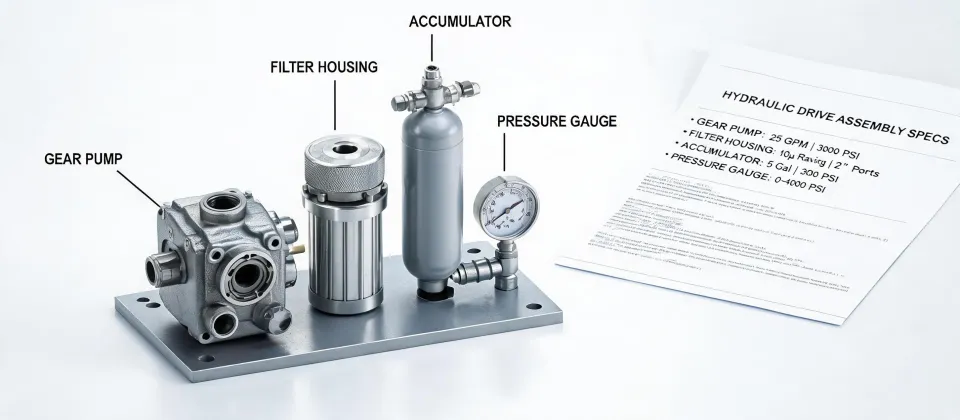
If that 5HP motor is spinning a hydraulic pump, you're in constant-torque territory. HYDAC's pump line — gear pumps, vane pumps, radial piston pumps — all falls into this category. Plan accordingly.
Step 5: Size by Current, Not Horsepower
Here's the formula I keep on a sticky note:
- Variable torque: VFD rated current ≥ motor FLA × 1.1
- Constant torque: VFD rated current ≥ motor FLA × 1.25
For a 5HP, 460V motor at 7.6A FLA, that means:
- Variable torque: bare minimum 8.4A continuous
- Constant torque: at least 9.5A continuous
Most manufacturers list normal-duty and heavy-duty ratings on the same drive. A 5HP VFD in heavy-duty mode is typically rated around 9.5–10A, which is exactly why "size up one frame" shows up so often in real-world advice. It's not blind caution — it's the math.
Step 6: Check Cable Length and Power Quality (The One Most People Skip)
If the motor cable run from the VFD is longer than about 50 feet, plan on an output reactor. Long cable runs create reflected voltage waves that stress motor insulation. I've seen a VFD run flawlessly with a 30-foot lead, then fault repeatedly once somebody extended the run to 120 feet.
On the supply side, if the facility has other VFDs, welding equipment, or generally poor power factor, add a line reactor. It's one line item that prevents a disproportionate share of nuisance trips.
Step 7: Don't Skip the Motor Health Check — and Know the Servo Motor Repair Difference
If you're replacing a VFD because of a motor failure, verify the motor is worth keeping before you spend money.
- Spin the shaft by hand and listen for bearing grinding.
- Meg the windings. Anything below 10 MΩ needs investigation.
- Confirm the mounting dimensions. A 5HP motor comes in multiple frame sizes, and they aren't interchangeable.
If the failed motor is a servo motor, that's a completely different diagnostic path. Servo motor repair involves more than checking windings and brushes — the feedback encoder or resolver is often the root cause of the fault. I've watched facilities spend $1,800 on a servo repair and then burn another full day of production because they reused the old encoder. Always ask for a diagnostic report before authorizing servo motor repair work, and budget for a replacement encoder if there's any doubt.
Step 8: Plan the Spare Parts Strategy Before You Need It
This is the boring step nobody wants to deal with. It's also what separates a one-day outage from a five-day outage.
If you can't name the filter element, seal kit, coupling, and contactor part numbers for your motor-drive system without going to look, that's a vulnerability — not a minor detail.
Here's a concrete example. When a client asks me to source HYDAC industrial spare parts, the first thing I do is verify the exact part number stamped on the old component. A 30-second match test beats a week of waiting for the wrong filter element. And if a supplier offers you a cheaper "cross-reference" part, be careful. In hydraulic filtration, compatible on paper doesn't always mean compatible under load. The OEM part costs more upfront and less over the life of the pump — that's the total-cost math that actually wins.
The Mistakes I See Most
Here's what actually goes wrong in the field, in order of how often I've seen it:
- Sizing by HP alone. I've done it, and it fails. Use the current numbers.
- Voltage-class errors. A buyer once ordered eight drives at the wrong voltage and lost two weeks of production waiting for replacements.
- Ignoring the mechanical side. A filter, coupling, or bearing failure always shows up as a motor current problem. Fix the load, or the new VFD trips just like the old one.
- Reusing a feedback encoder on a repaired servo motor. You're trading today's problem for tomorrow's.
- Buying "compatible" hydraulic parts to save $20. The total cost of a premature pump failure — replacement part, labor, downtime — will always exceed the money saved at checkout.
Bottom Line
Sizing a VFD for a 5HP motor isn't hard once you have the right framework: nameplate data, actual current draw, line voltage, load type, and the mechanical system around the motor.
Most of this advice assumes a standard 3-phase induction motor in a typical industrial environment. If you're dealing with something unusual — a reconditioned motor, a vertical mount, an explosion-proof enclosure, or a cable run over 150 feet — stop and get someone who knows your application to double-check the numbers. The VFD is a tool, not a guarantee.
The last three emergency calls I handled were all "caused" by a VFD. None of them were. One was a clogged hydraulic filter. One was a coupling that was two months past its replacement interval. One was a motor with a failing bearing that should have been repaired six months earlier. The drive was just the messenger.