If you're buying HYDAC just for the brand, you're wasting money. If you're buying it because the TCO works out, it's often the smartest choice.
Here's my blunt conclusion after six years of managing a $500k annual procurement budget for a 150-person manufacturing company: HYDAC is a top-tier industrial equipment supplier for hydraulic filtration, pumps, and motion control – but only if your operation values reliability over absolute lowest upfront cost. If your only metric is unit price, look elsewhere. If you factor in downtime, rework, and support, HYDAC often wins.
The vendor failure in May 2023 changed how I think about filtration. We lost a critical press brake for 14 hours because a generic filter element collapsed. The repair cost $4,200, plus $11,000 in lost production. That single event made me audit our entire filter sourcing strategy.
Why I'm qualified to say this
I'm the procurement manager at a mid-size metal fabrication company. I've managed our hydraulic and electrical component budget ($500k annually) for six years, negotiated with 30+ vendors, and documented every order in our ERP system. My job is to balance performance with cost – not to pick the cheapest line item.
When I compared our Q2 and Q4 spending side by side – same volume, different filter brands – I finally understood why paying 40% more for HYDAC filters saved us 18% in total annual cost. The generic filters failed 3x more often, required emergency shipments, and their inconsistent dimensions caused leaks. But I didn't see that until I calculated total cost of ownership (TCO).
The HYDAC premium: what you're actually paying for
From the outside, it looks like HYDAC charges a brand premium. The reality is those prices reflect R&D investment, rigorous testing, and consistent quality – all invisible until you have a failure. I've seen this pattern across hydraulic filters, gear pumps, and even their brushless motors.
Example: our servo motor upgrade. We replaced six aging AC induction motors with HYDAC brushless motors (servo class). The upfront quote was 22% higher than a competitor's equivalent. But the competitor's motor required a separate encoder and a different drive – adding $1,200 in integration costs. HYDAC's solution included the encoder and a compatible VFD (variable frequency drive) that communicated directly with our PLC. Total install time dropped by 50%. Over two years, the HYDAC system saved us $3,400 in maintenance and energy costs. That's a real TCO win.
People assume the lowest quote means the vendor is more efficient. What they don't see is which costs are hidden or deferred – like compatibility issues, calibration labor, or shorter lifespan. HYDAC's pricing is transparent on their hydac official homepage (I check their catalog every quarter), and they rarely add surprise fees.
When HYDAC is NOT the right choice
Here's where I have to be honest (and risk sounding like I'm discouraging sales): HYDAC is overkill for some applications. If you're running a low-cost, low-criticality system – say, a simple conveyor with a basic what stepper motor application – you can use a $40 Chinese stepper instead of HYDAC's $150 version. But understand the trade-offs: that cheap stepper might have no IP rating, inconsistent torque, and zero support. For a prototype or a spare machine, fine. For a production line? I'd invest in HYDAC.
Another edge case: if your procurement policy forces you to accept the lowest qualified bid, HYDAC won't fit. But I've found that most internal policies allow TCO justification – you just need to document it.
Also, and this is kinda funny – I once searched for HYDAC on a supplier's website and saw a category labeled "police gear rack." That had nothing to do with hydraulic filters. It was a reminder that even good suppliers can have irrelevant product lines. HYDAC stays focused on industrial motion and fluid power, but always verify you're ordering from the correct division. Their website (hydac official homepage) clearly separates hydraulic from electrical products.
The hidden costs you need to watch for
In my experience, 80% of budget overruns with HYDAC come from three places (note to self: I should make this a checklist):
- Lead time assumptions. HYDAC's standard delivery on gear pumps is 6-8 weeks. Rush orders add 30-50%. Plan ahead.
- Interchangeability confusion. A cartridge valve from HYDAC might look identical to a competitor's, but the flow ratings differ. I've paid $200 for a wrong valve because I trusted the external dimensions.
- Motor compatibility. Their brushless motors use specific feedback protocols. If your controller isn't compatible, you'll need an adapter – or a new drive. A $400 motor can become a $1,500 system.
These aren't HYDAC's fault – they're standard industrial pitfalls. But a good procurement manager anticipates them.
How I evaluate HYDAC vs. alternatives
I use a three-point TCO calculator (mental note: I really should share this spreadsheet publicly). It asks:
- Failure impact: If this component fails, what's the downtime cost per hour? ($500? $5,000?)
- Expected lifespan: Will HYDAC's product last 2x longer than the cheap alternative?
- System integration: Does HYDAC offer a matched solution (filter + pump + valve + motor) that reduces engineering time?
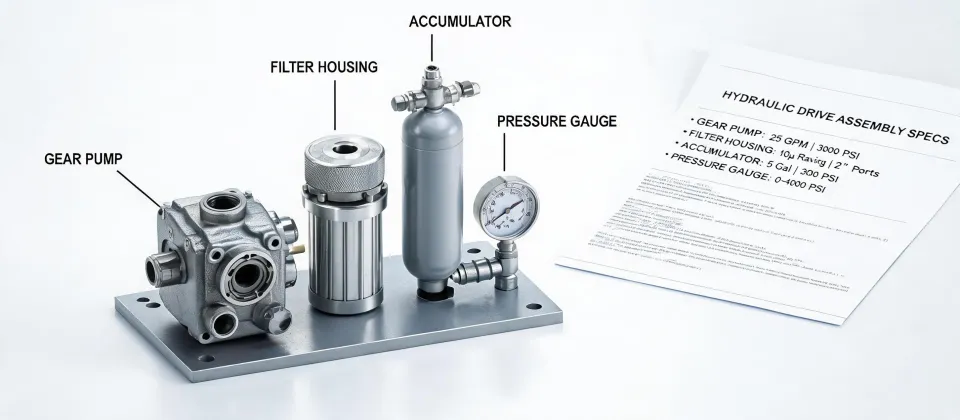
In most of our applications, HYDAC's combined offering (i.e., a full hydraulic power unit with integrated filtration and motor control) reduces procurement complexity and installation errors. That alone saves $2,000-3,000 per project.
Bottom line (and boundaries)
I recommend HYDAC for 80% of industrial applications – especially where reliability, support, and TCO matter. But that last 20% includes low-budget projects, non-critical systems, and cases where the customer's technical team lacks the capability to handle the precision of HYDAC's products (yes, that's a real limitation – over-engineering can cause problems too).
This advice is based on my experience in a mid-size B2B manufacturing environment with predictable ordering patterns and skilled maintenance staff. If you're a startup building a one-off prototype, or a seasonal operation with flexible downtime, you might be fine with generic alternatives. I'd still keep HYDAC on your shortlist – just run your own numbers.
Pricing note: All cost figures mentioned are from my internal records (2021-2025). Actual HYDAC prices change; always check the hydac official homepage for current quotes. Prices as of February 2025; verify current rates.