-
Who This Checklist Is For
-
The 6-Point Pre-Order Checklist
-
Step 1: Verify the Part Number—Don't Trust Memory
-
Step 2: Give the Reseller a Reference, Not Just a Description
-
Step 3: Check Voltage and Frequency Before Ordering Motors or Drives
-
Step 4: Verify the Application—Not All Gear Units Are Interchangeable
-
Step 5: Confirm the Environment—Especially for Furnace and High-Temperature Applications
-
Step 6: Double-Check Your Own Part Number Before Sending the PO
-
Step 1: Verify the Part Number—Don't Trust Memory
-
Common Errors After the Order Arrives
-
Why I Trust the Catalog More Than My Memory
I've been handling industrial equipment orders for about six years now. In that time, I've made my share of expensive mistakes—the kind that make you sit at your desk after the parts arrive and just stare at them. Wrong part numbers, mismatched motor voltages, a servo motor with the wrong feedback type, a bevel gear unit with the shaft on the wrong side. The list goes on.
After the third costly error in Q1 2024, I finally sat down and wrote out a pre-order checklist for our team. It's not fancy. It's just the things I wish someone had told me before I ordered $3,200 worth of the wrong hydraulic filters.
If you regularly order HYDAC components—or any industrial parts, really—this list will save you money. I've documented enough of my own failures to know that most of them were avoidable with ten extra minutes of checking.
Who This Checklist Is For
This is for maintenance engineers, procurement staff, and system integrators who order HYDAC products or similar industrial components. It assumes you're not a hydraulics specialist—you just need the right part to arrive on time and work correctly.
Here's the thing: I'm not a design engineer. I'm the guy who places the orders and then has to explain to production why the line is down. Most of what I've learned came from mistakes, not training.
The 6-Point Pre-Order Checklist
Step 1: Verify the Part Number—Don't Trust Memory
The first mistake I made as a beginner was assuming I remembered the part number correctly. I'd ordered the same filter element three times, so I figured I knew it. On the fourth order, I typed the number from memory and didn't check. It was one digit off—a different micron rating. The filters arrived, didn't fit the housing, and I had to pay return shipping plus a restocking fee. Around $450 wasted.
The correct process is simple:
- Find the part number on the existing component's nameplate or housing, not from memory.
- Cross-reference it in the HYDAC catalog PDF (the latest version, not the one from three years ago).
- If the part has been superseded, write down both the old and new numbers.
I keep a folder of HYDAC catalog PDFs on my desktop, sorted by date. When I'm unsure about a revision, I check the publication date. Older catalogs sometimes list obsolete part numbers that have been replaced—ordering from an outdated catalog is how I ended up with a box of obsolete seal kits I still haven't used.
Step 2: Give the Reseller a Reference, Not Just a Description
When I first started ordering through a reseller, I'd write something like "hydraulic filter for the 200-bar system." That's useless. Resellers handle hundreds of parts per week; they're not going to guess which filter you need.
Now I provide the full HYDAC catalog reference, including the catalog section if I have it. For example, instead of "gear pump for the power unit," I write:
"HYDAC gear pump, type KF 4/16 P, with SAE flange, clockwise rotation. Confirm pressure rating 250 bar."
Just as important: ask the reseller if the item is in stock or needs to be ordered. I once assumed a reseller's website stock indicator was accurate. It wasn't. The part wasn't actually available for three weeks, and the whole maintenance shutdown got delayed. The cost of the part was $300; the cost of the idle production line was considerably more.
If you're working with a new HYDAC industrial equipment reseller, don't be afraid to ask the name of the person you're emailing with. A real person beats a ticket system every time when you need troubleshooting after delivery.
Step 3: Check Voltage and Frequency Before Ordering Motors or Drives
This is the one that I still kick myself about. A few years ago, I ordered an induction motor for a furnace application. I knew the furnace was running on 480 V, but I didn't check the motor nameplate on the old unit. I ordered a 400 V motor. When the electrician tried to wire it, the motor was drawing excessive current. We caught it before damage, but it cost a week of electrical rework and a $500 expedite fee for the correct unit.
Before ordering any motor, drive, or actuator:
- Check the nameplate voltage and frequency on the existing unit.
- Compare with your actual supply voltage, not what you assume it is.
- For VFDs, verify the input phase configuration and the motor's cable length.
On the topic of servo motor news—the industry is pushing toward higher-resolution feedback systems. That's great, but it means replacement motors are sometimes bundled with a new feedback cable or even a different drive. If you have a servo system that's five-plus years old, don't assume plug-and-play compatibility. Check the feedback encoder type (EnDat, Hiperface, resolver, etc.) and the connector style. I once ordered a new servo motor for an aging axis drive and discovered that the feedback connector had been changed. Nothing worked until I ordered the adapter cable.
Step 4: Verify the Application—Not All Gear Units Are Interchangeable
This is where the phrase "what uses a bevel gear" actually matters. Bevel gears are used to change the direction of power transmission shafts—typically in right-angle drive applications like conveyor drives, augers, and some hydraulic power take-offs. But the idea that a right-angle bevel gearbox can do any job is wrong.
I ordered a right-angle bevel gearbox once to replace a worn unit. I knew the ratio was 2:1 and the shaft sizes matched. What I didn't check was the mounting orientation. The new gearbox had the output shaft on the opposite side. It was physically compatible but functionally wrong for the application. We had to modify the mounting plate to make it work—not a huge problem, but it added stress in a place where we didn't need it.
When you're ordering any gear reducer or bevel gear unit, write down:
- Gear ratio
- Shaft orientation (output shaft direction relative to the input)
- Mounting foot position
- Torque rating
- Lubrication type (oil-filled vs. grease-packed)
Don't trust drawings from memory. Take a photo with your phone and send it to the reseller. One photo saves a thousand words—and about two weeks of waiting when the wrong unit arrives.
Step 5: Confirm the Environment—Especially for Furnace and High-Temperature Applications
This one is less common, but worth its own step. When you're dealing with induction motor furnace applications or any high-temperature environment, the motor's insulation class and cooling method matter. A standard enclosed fan-cooled motor might not survive near a furnace if ambient temperatures exceed the motor's rated maximum. I've seen a motor that ran fine for months in a cool shop get installed near a heat source and trip on thermal overload repeatedly.
If you're ordering motors or filters for a furnace area, tell the reseller about the ambient temperature. HYDAC's filter products, for instance, have viscosity and temperature limits that vary by seal material (NBR vs. FKM). I learned that the hard way when a FKM seal was necessary for high-temp oil but my supplier defaulted to NBR. In a warm machine room, the NBR seals started leaking after two months.
My rule: if the installation environment is anything other than "typical clean factory," say so up front. Let the supplier or reseller flag compatibility issues before you order, not after.
Step 6: Double-Check Your Own Part Number Before Sending the PO
You'd think this goes without saying. But in the last year, the single most common error on our team has been a wrong digit in a long part number. A HYDAC cartridge valve with the designation "RVP 10" vs. "RVP 8"—they look similar, but they're completely different sizes.
My checklist now includes a final verification step:
- Read the part number aloud and compare to the nameplate or original drawing.
- Type the part number into the HYDAC catalog PDF's search function, not just Google.
- Confirm that the description in the reseller's quote matches the component you need—not just the part number.
I can't tell you how many times a reseller's quote listed the right part number but the wrong description. If I hadn't read the description, I'd have approved a quote for a flow-control valve when I needed a pressure valve. Same part number family, completely different function.
Common Errors After the Order Arrives
Even if you do everything right, check the delivered goods before you cancel the maintenance window or send a team to install. Here's what I've seen go wrong:
- Wrong seal kit in the box: The box label said the right part number, but the bag inside was from a different vendor's stock.
- Damaged threads: A cartridge valve arrived with a damaged thread and the seller's paperwork didn't mention it. We inspected it and caught it before installation.
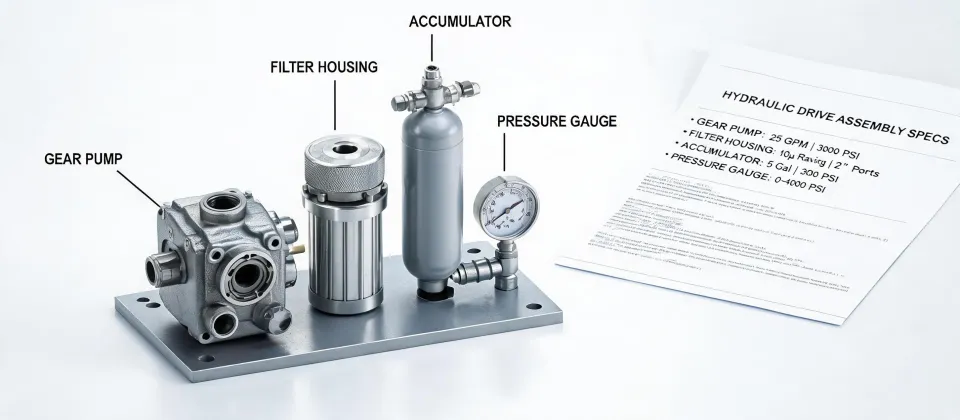
- Direction of rotation: A gear pump can be left or right handed. If you order "hydac gear pump" without specifying rotation, you might get the wrong one. Check the arrow on the pump housing and compare with the original.
The inspection takes about five minutes. The cost of not doing it: potentially a second order, a longer delay, and another round of shipping costs.
Why I Trust the Catalog More Than My Memory
My experience is based on roughly a hundred and fifty orders, most of them in the $500–$3,000 range. If you're working with different types of equipment—maybe more specialty automation or larger hydraulic systems—your experience might differ. But I've learned one thing that applies broadly: the HYDAC catalog is more accurate than my recollection of what worked last time.
I still keep notes on every order: date, part number, application, notes from the reseller. It's not a fancy system—just a spreadsheet I update weekly. It's saved me from repeating several mistakes, and it gave me the data behind this checklist. Five minutes of verification beats five days of correction, every time.