-
1. Match the specs to your worst-case operating conditions
-
2. Verify mounting, shaft, and port dimensions before you place the PO
-
3. Confirm the duty cycle and environment
-
4. Decide what happens when the actuator fails — before it fails
-
5. Get the manual before the equipment arrives
-
6. Calculate total cost of ownership, not just the invoice
-
7. Plan for maintenance access and spare parts before the system is built
-
A few things this checklist is not
If you're ordering a hydraulic gear pump, an electric linear actuator, or a servo motor for an industrial application — and you're not 100% sure which specs actually matter — this checklist is for you.
I've managed procurement for drive components at a mid-sized automation company for the past 6 years. That's roughly $180,000 in cumulative spend on pumps, actuators, filters, and servo systems, every order tracked in our cost system. I've also made mistakes that a 5-minute check would have caught. These are the 7 checks I now run on every order.
- Match specs to your worst-case operating conditions
- Verify mounting, shaft, and port dimensions
- Confirm the duty cycle and environment
- Decide what happens when it fails
- Get the manual before the equipment arrives
- Calculate total cost of ownership, not invoice price
- Plan for maintenance access and spare parts
1. Match the specs to your worst-case operating conditions
Not your typical conditions. Your worst-case. That's a distinction I learned the hard way.
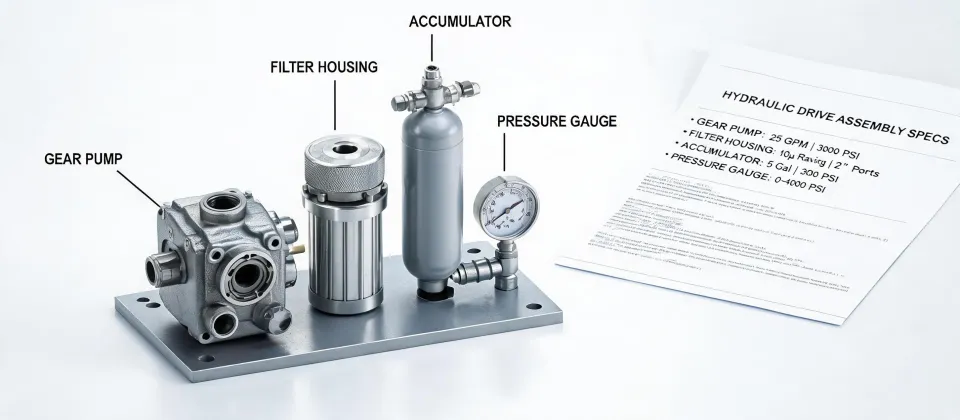
For a hydraulic gear pump, check displacement (cc/rev) and flow at your operating RPM, continuous and peak pressure ratings, fluid viscosity range, and speed limits. For a linear actuator, check force rating — both dynamic and holding — plus stroke, speed, and duty cycle. For a servo motor, check rated torque, peak torque, and the inertia match between motor and load.
Our worst mistake here: we ordered a gear pump rated for 3,000 psi continuous because that's where the system ran most of the time. But at cold start, pressure spiked to 4,200 psi — above the pump's peak rating. The HYDAC manual for that model stated the peak pressure limit on page two of the spec section. I didn't read it during the spec review. Three weeks after installation, the shaft seal started leaking. I still kick myself over that one.
2. Verify mounting, shaft, and port dimensions before you place the PO
A part number can be cross-referenced correctly, and the physical interface can still be wrong. Gear pumps use SAE flanges — A, B, C — and shafts come keyed, splined, or tapered. Linear actuators have different clevis and pin options. Servo motors have NEMA or IEC flange patterns, and the encoder connector can be the thing that gets you.
We didn't have a formal dimension verification process when I started. The third time we ordered a gear pump with the wrong flange size and paid a restocking fee, I made it a rule: every PO line gets a dimension sign-off from an engineer, checked against the drawing in the catalog or manual. The part number alone doesn't tell you if the shaft is 7/8" or 1".
Checkpoint: has someone looked at the dimension drawing — not just the part number?
3. Confirm the duty cycle and environment
An actuator that runs three cycles a day in a clean shop is a different component from one cycling 200 times an hour in a washdown area. Verify the rated duty cycle at your actual load. Verify the IP rating of the enclosure.
We once bought an electric actuator with an IP54 rating for a line that spec'd IP65. Someone decided IP54 "would probably be fine." It wasn't. The first high-pressure spray shorted the limit switch. The replacement — parts and labor — cost four times the price difference between the IP54 and IP65 versions.
Here's the thing: that math repeats itself all over this industry. Saving a small amount on the component costs a large amount on the consequence.
4. Decide what happens when the actuator fails — before it fails
"What happens when a linear actuator fails?" is one of those questions buyers tend to avoid until something stops working. But the answer matters. Here's what the failure modes usually look like:
- Stall — motor overloads, actuator stops mid-stroke
- Drift — internal clearances let the load creep back (common with leadscrew wear)
- Lockup — gearbox jams, no movement at all
- Runaway — controller fault drives the actuator hard into a limit
If that actuator is moving a valve, a damper, or anything safety-related, the failure position is critical. Does it fail in place? Does it go to a safe position? Is a spring-return or mechanical override available?
I'll be honest about a regret here. When I first bought an electric actuator for a diverter valve — back in 2021 — I didn't ask about fail-safe behavior. The cheaper unit didn't have a spring return. When the controller died one afternoon, the valve froze mid-position. We drained and reworked 600 gallons of mixed product. The spring-return option would have added maybe $300 to that order. Looking back, I should have asked the question before the PO, not after the incident.
5. Get the manual before the equipment arrives
Nobody reads the manual first. Then, when something leaks or vibrates or stops working, everyone goes looking for it. But the manual contains more than troubleshooting steps — it contains the specifications that prevent the failure in the first place.
For a HYDAC gear pump, that includes mounting bolt torque specs, coupling alignment tolerances, filter bypass settings, and the recommended fluid cleanliness level — usually expressed as an ISO 4406 code. If your filter isn't selected to meet that code, the pump won't live as long as the design intends.
Our process gap: we didn't have a formal step to pull the manual before installation. A few years back, coupling misalignment caused a seal failure. The tolerance was right there in the manual's installation section — nobody had opened it. Now, no installation starts until the relevant manual pages are printed and attached to the work order. Sounds bureaucratic, but the third time a 5-minute manual check would have saved us a repair, we made it a rule.
6. Calculate total cost of ownership, not just the invoice
Price is what you pay. Cost is what you deal with afterward.
When we compared replacing two worn HYDAC gear pumps with a lower-priced import brand in Q2 2024, the imports quoted about 35% less per unit. But the quote didn't include spare parts availability (limited), technical support in our time zone (none), or a complete service manual (partially translated PDF). When one failed at month 8, the replacement took 6 weeks to arrive. Line downtime cost us roughly $1,800 per day. The 35% savings disappeared by day three.
Smaller example, more embarrassing: I once saved $80 by changing a linear actuator from expedited to standard shipping. Standard delivery missed our installation deadline, and we paid $400 for an expedited reorder. Net loss: $320, all to save $80. Most of the time that move works fine. The one time it didn't, it cost four times what I saved.
Ask about lead time, warranty terms, spare parts availability, and documentation quality. Those are part of the price.
7. Plan for maintenance access and spare parts before the system is built
This is the step most people ignore, because it's about the future, and the future isn't urgent right now. But ask anyway: when the filter element needs changing, can someone actually reach it? Can you replace the actuator seal without pulling the whole assembly apart? Do you know the replacement filter part number before the machine ships?
With HYDAC products, filter maintenance is generally well designed — it's the core of their business. Replacement elements are documented, and the filter catalogs are usable. But that doesn't help if the machine design puts the filter behind a structural beam. Catching that on paper is free; catching it in year two is not.
Spare parts follow the same logic. If you don't have a spare parts plan for critical components, you're not buying a component — you're buying a future crisis. We didn't have a formal spare parts planning process for years. It cost us once when our only spare gear pump was the one already inside the machine. Two pumps on the shelf for a critical application is not excessive. It's cheap insurance compared to a shutdown.
A few things this checklist is not
Honest limitation: this checklist is for industrial applications — equipment that keeps a plant running, safety circuits, anything where a failure has consequences. If you're building a bench prototype or a hobby rig — say, controlling a servo motor with an Arduino — most of this is overkill. You don't need ISO 4406 cleanliness codes or a fail-safe analysis for a workbench experiment. You need a motor that matches your power supply and an encoder your controller can read.
The opposite error is just as real. We once spent close to $1,200 on an industrial actuator for a prototype fixture that would have been fine with a $150 unit. Over-specifying because you're not sure what you need is a different form of waste.
And one more: don't use this checklist as a substitute for talking to a qualified distributor or the manufacturer's application engineers. A manual won't cover your specific fluid type, ambient temperature, or vibration profile. The person who sells these components every day will. I've been saved more than once by asking a question that wasn't in the datasheet.
These 7 checks started because I was tired of rectification costs. They won't catch every mistake — but they've caught enough to pay for themselves many times over.