-
Who This Checklist Is For (And Why You Need It)
-
Step 1: Confirm the Exact HYDAC Model — Don't Trust the Label Alone
-
Step 2: Verify the Servo Motor Pinout — Twice, With a Multimeter
-
Step 3: Measure Twice, Order Once — Especially for Linear Bearings
-
Step 4: Cross-Check Component Compatibility Before You Approve the PO
-
Step 5: Always Request the Documentation Before You Order
-
Common Mistakes I Still See (And How to Avoid Them)
Who This Checklist Is For (And Why You Need It)
If you're ordering industrial components like HYDAC gear pumps, servo motors, or linear bearings — and you've ever had to eat the cost of a wrong part — this is for you. I've been handling component procurement for about six years, and I've personally made (and documented) at least a dozen serious mistakes that totaled roughly $8,200 in wasted budget. Now I maintain our team's checklist. This one covers the five most common screw-ups I've seen (and caused) with HYDAC parts, servo repair, and bearing sizing.
Step 1: Confirm the Exact HYDAC Model — Don't Trust the Label Alone
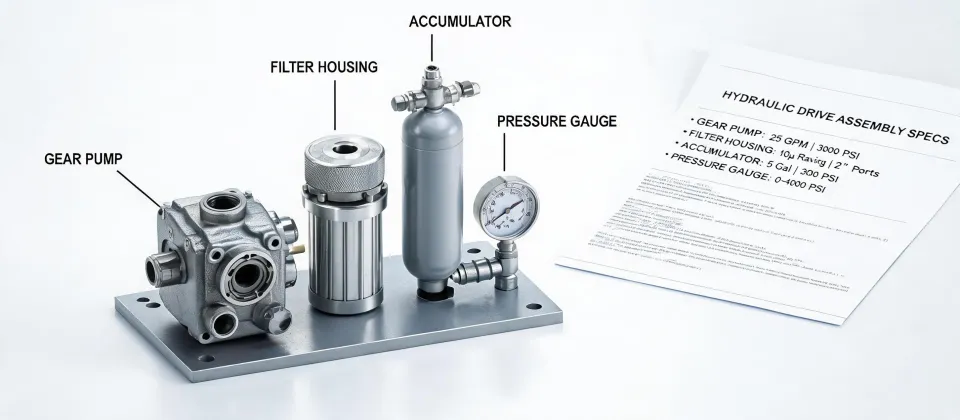
In my first year (2017), I ordered a HYDAC gear pump based on the part number stamped on the old unit. Turned out the original pump had been replaced once before with a cross-referenced model, and the stamp was from the replacement — not the original spec. The new pump didn't fit the mounting bracket. $380 down the drain, plus a two-week delay.
What to do instead: Always pull the official datasheet from HYDAC's website and verify the model against the fluid, flow rate, and port configuration — not just the number on the nameplate. If possible, take a photo of the existing installation and compare port locations.
Step 2: Verify the Servo Motor Pinout — Twice, With a Multimeter
I once told a technician, "Just match the colors to the existing connector." He heard "Use the same wire positions." The result? A freshly repaired servo motor that was wired backwards — the encoder feedback was swapped with the power phase. The drive fried itself the moment we powered it up. That $890 mistake (plus a $1,200 drive replacement) taught me to never trust wire color guessing.
The checklist action: Before connecting any repaired servo motor, always compare the servo motor pinout against the drive manual. Use a multimeter to confirm continuity on each pin. I've caught three potential mismatches this way just in the past 18 months. If you're unsure about terminology (like "U-V-W" vs. "R-S-T"), look up the manufacturer's exact naming — they don't always match.
Step 3: Measure Twice, Order Once — Especially for Linear Bearings
Someone asked me "what size is LM8LUU linear bearing" during a rush order. I quickly checked a table: 8mm inner diameter, 15mm outer, 24mm length. Ordered 20 pieces. When they arrived, the shaft diameter was 8mm, but the bearing length was wrong — the application needed a longer version (LM8LUU vs. LM8LUU-OP). The difference? 4mm. We had to rush-order the correct ones overnight at +60% premium.
The fix: When ordering linear bearings, always note the full designation (LM8LUU is just the basic type — variations like LM8LUU-OP add an oil hole location suffix). Measure the existing housing depth and shaft shoulder spacing. And don't rely on memory — I keep a printed cheat sheet near my desk (circa 2024, still valid).
Step 4: Cross-Check Component Compatibility Before You Approve the PO
This is where communication failures really sting. I said "we need a 0.75kW servo motor with 2500-line encoder." The sales engineer heard "a standard 0.75kW AC motor with a resolver." We were using the same words but meaning different things. Discovered this when the motor arrived and the feedback connector didn't match our drive. That mismatch cost $450 in re-stocking fees plus a 1-week delay.
Step 4 checklist: Create a "compatibility matrix" for every order — motor brand + drive brand + feedback type + cable pinout. I now include a column in my purchase requisition that says "Electrical interface verified?" and don't approve until someone checks it. It sounds obvious, but most mistakes happen because we assume the supplier knows what we mean.
Step 5: Always Request the Documentation Before You Order
On a $3,200 order for a HYDAC gear pump and a servo drive, I approved everything based on a verbal quote. When the items arrived, the pump had SAE ports (we needed BSP), and the servo drive manual was in German — we needed English. Getting the correct manual took five days of back-and-forth. The pump return cost $95 in shipping. Now my rule: never approve a PO without the datasheet and manual file numbers in the system.
Common Mistakes I Still See (And How to Avoid Them)
- Using generic search queries — "HYDAC pump" instead of the full part number like HYDAC KF30/50 NP-D 15. Always include the catalog prefix.
- Assuming standard pinouts — Servo motor manufacturers vary wildly. Even within the same brand, different series use different encoder wiring.
- Ignoring bearing length tolerances — LM8LUU is a standard size, but actual length can vary by ±0.5mm between manufacturers. For precision fits, check the drawing.
My last piece of advice: the 12-point checklist I created after my third mistake has saved us an estimated $8,000 in potential rework. Five minutes of verification beats five days of correction — I learned that the expensive way so you don't have to.